The Desert Near Marrakech That Is Not What You Expect
When people hear "desert near Marrakech," they picture sand dunes. Camel caravans crossing golden ridges. Lawrence of Arabia on a budget. The Agafay Desert is none of that, and it is far more interesting because of it.
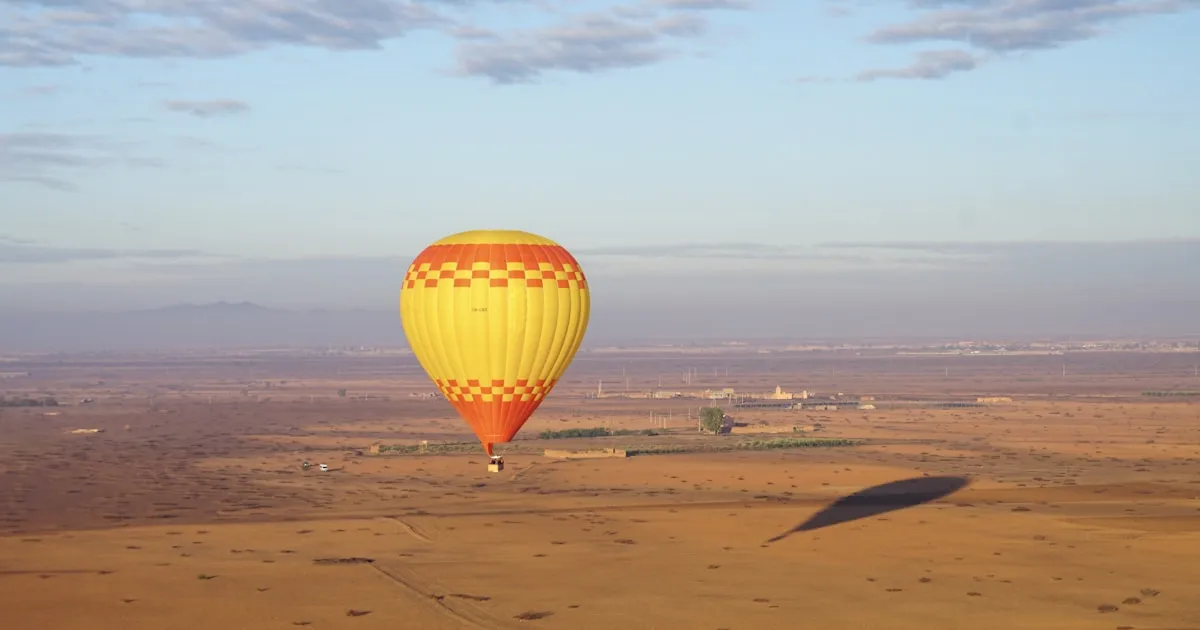
The Agafay Desert sits roughly 30 kilometres south-west of Marrakech, a vast expanse of rocky, barren terrain that looks more like the surface of the moon than anything from a Saharan postcard. There is no sand. The ground is hard-packed earth, cracked stone and ochre-coloured clay, broken only by sparse tufts of scrub grass and the occasional twisted tree. It is a landscape stripped down to its bones — and once you see it with your own eyes, it is one of the most visually striking places in Morocco.
The Agafay is one of the most popular day-trip destinations for visitors to Marrakech, and it pairs perfectly with a sunrise hot air balloon flight: the balloon in the morning, the desert in the afternoon. Here is everything you need to know about the Agafay Desert — what it is, what to do there, and how it fits into a well-planned Marrakech itinerary.
A quick note on balloon launch sites. Our own sunrise balloon flights in Marrakech do not launch from the Agafay Desert — they launch from the Palmerie, on the northern edge of Marrakech, and drift over palm groves, Berber villages and the Atlas foothills. If you are booking our Classic Flight, Private Flight or VIP Flight, the Agafay is not where you will be flying. But it is an excellent place to visit on the same trip — either as an afternoon add-on after your balloon flight, or as a standalone day out.
Geography and Landscape
A Rocky Desert, Not a Sandy One
The Agafay Desert is technically not a desert in the classic sense. Geographers classify it as a rocky, semi-arid plain — part of the broader Jbilet hills region that stretches across the landscape north-west and south of Marrakech. The Jbilet plains are among the oldest geological formations in Morocco, composed of Precambrian and Palaeozoic rock that has been eroded over hundreds of millions of years into the flat, barren expanse you see today.
The terrain is ochre, rust and pale grey. Low ridges of exposed rock alternate with flat stretches of compacted earth. Dried riverbeds — oueds — cut shallow channels across the surface, carrying water only during the brief winter rains. The vegetation is minimal: low thorny bushes, wild thyme and esparto grass that clings to the ground in scattered patches. In the dry months, from June through September, the landscape is almost entirely monochrome.
Elevation and Position
The Agafay Desert sits at approximately 500 metres above sea level, on a gently undulating plateau that tilts gradually upward toward the south. To the south and southeast, the High Atlas Mountains rise abruptly from the plain, their peaks reaching over 4,000 metres. Jebel Toubkal, the highest summit in North Africa at 4,167 metres, is visible from the Agafay on clear days, roughly 40 kilometres away as the crow flies.
To the north and east, the terrain flattens further into the Haouz Plain, the vast agricultural basin that surrounds Marrakech. The city itself is invisible from most points in the Agafay — no high-rises, no urban glow, just open space in every direction.
The Jbilet Hills Connection
The Jbilet hills are a low-lying mountain range — barely hills by most standards, topping out around 1,000 metres — that run roughly east-west across this part of Morocco. The Agafay Desert occupies the southern fringe of this formation, where the Jbilet fades into the flat approach to the Atlas range. The rock here is ancient: schists, quartzites and granites that predate the Atlas Mountains by several hundred million years.
This combination of flat, open terrain and the Atlas Mountain backdrop is what makes the Agafay such a dramatic landscape to visit on the ground — whether you are quad biking across it, camel riding through it, or sleeping in a desert camp under its skies.
What to Do in the Agafay Desert
The Agafay Desert has become one of the most popular activity destinations near Marrakech. Whether you are already making the trip out for a morning balloon flight over the Palmerie or heading to the Agafay as a standalone day trip, there is plenty to fill an afternoon, an evening, or a full day.
Quad Biking and Buggy Tours
This is the single most popular Agafay activity. Guided quad bike excursions take you across the rocky terrain at speed, kicking up dust along trails that wind between ridges and dry riverbeds. Tours typically last 2 to 3 hours and cover 20 to 30 kilometres of off-road terrain. Buggy tours offer a similar experience with a roll cage and seat belt for those who prefer four wheels to two.
Quad biking is the classic pair-up with a morning balloon flight: you get the quiet, panoramic view from the Palmerie at dawn, then the visceral, ground-level thrill of crossing the Agafay at speed in the afternoon.
Luxury Desert Camps
Over the past decade, a string of high-end glamping sites have appeared across the Agafay. These range from simple Berber-style tented camps to full luxury resorts with swimming pools, spa facilities and multi-course dinner service. Most offer sunset packages: arrive in the late afternoon, watch the sun drop behind the Atlas foothills, dine under the stars, and sleep in a furnished tent. It is the Sahara experience without the 10-hour drive.
Camel Riding
Camel rides through the Agafay offer a slower, more traditional way to experience the landscape. Most excursions last 1 to 2 hours and follow established routes through the rocky terrain with Atlas Mountain views throughout.
Stargazing
The Agafay's distance from Marrakech means minimal light pollution. On a clear night — and most Moroccan nights are clear — the sky is extraordinary. The Milky Way is visible to the naked eye, and the lack of humidity means the stars appear sharp and bright. Several of the desert camps offer guided stargazing sessions with telescopes.
Horseback Riding
For experienced riders, horseback excursions across the Agafay are available. The terrain is varied enough to offer both gentle walks and more challenging canters across open ground. Most rides last 1.5 to 2 hours and include views of the Atlas range throughout.
Dinner Under the Stars
Even without an overnight stay, many operators offer evening-only packages: a 4x4 transfer from Marrakech, a sunset viewpoint stop, and a traditional Moroccan dinner — tagine, couscous, grilled meats — served at a candlelit table in the open desert. The drive back to the city takes 30 to 45 minutes.
How the Agafay Compares to the Sahara
This is the question every visitor asks, and the honest answer matters.
The Agafay Desert is not the Sahara. It is a rocky, barren landscape — visually dramatic in its own way, but fundamentally different from the towering sand dunes of Erg Chebbi or Erg Chigaga.
Here is a direct comparison:
- Distance from Marrakech: Agafay is 30 minutes by car. The Sahara (Merzouga / Erg Chebbi) is 9 to 10 hours by road, or a short domestic flight plus a 45-minute drive.
- Terrain: Agafay is rocky, flat, moon-like. The Sahara has sand dunes reaching 150 metres high.
- Trip duration: Agafay is a half-day or day trip. The Sahara requires a minimum of 2 nights, ideally 3.
- Cost: An Agafay excursion costs a fraction of a Sahara tour.
- Experience: Both are genuine desert environments, but the character is completely different. The Sahara is vast, remote and overwhelming. The Agafay is accessible, intimate and surprisingly varied once you know where to look.
If you have 3 or more days in your Marrakech itinerary and you want the full Sahara experience, go to Merzouga. If you have 1 to 2 days and want a real desert experience without the travel commitment, the Agafay delivers. Many visitors do all three on the same trip — a sunrise balloon flight over the Palmerie, Agafay activities in the afternoon, then the Sahara later in the week. Our Marrakech itinerary guide shows how to fit everything in.
How to Get to the Agafay Desert
Most visitors reach the Agafay by booked tour or private 4x4 transfer from Marrakech. The drive takes 30 to 45 minutes, depending on your accommodation's location and traffic conditions.
The route heads south from the city, passing through Marrakech's outer suburbs before entering the rural outskirts. The landscape changes quickly: within 15 minutes of leaving the medina, the buildings thin out, the road narrows, and the flat, ochre terrain of the Agafay begins to dominate. The final stretch to most camps and activity sites is often on unpaved tracks, which is why a 4x4 is standard.
If you are booking activities directly with an Agafay operator (quad biking, desert camp, camel ride), they will usually include transfers in the package. Independent 4x4 hire is also available from Marrakech, but the off-road tracks can be confusing without local knowledge.
Best Time to Visit the Agafay Area
The Agafay Desert is accessible year-round, but conditions vary.
October to April is the ideal window for most outdoor activities. Morning temperatures are cool (5 to 15 degrees Celsius), the air is clear, and the Atlas Mountains are frequently snow-capped. Winter rains — brief and infrequent — can bring patches of green to the otherwise monochrome landscape, creating unusual photo opportunities.
May to September is hotter, with daytime temperatures regularly exceeding 35 degrees Celsius. Ground-based activities like quad biking and horseback riding are best done in the early morning or late afternoon to avoid the midday heat. The upside: fewer tourists, emptier skies and a landscape that glows in deep amber tones.
For the best months to fly a balloon over Marrakech, read our best time to fly guide.
Combining a Balloon Ride with Agafay Activities
One of the smartest ways to experience Marrakech's landscape is to combine a sunrise balloon flight with an afternoon in the Agafay. You see two completely different sides of the region in a single day — the green, lush Palmerie and the Atlas foothills from a balloon at dawn, then the stark, rocky Agafay from the ground in the afternoon.
Our balloon flights finish by mid-morning — typically around 8:30 or 9:00 AM, including the post-landing breakfast. That leaves the entire afternoon free. A popular combination:
- Dawn: Hot air balloon flight over the Palmerie with breakfast after landing
- Late morning: Return to your hotel, rest, freshen up
- Afternoon: 4x4 transfer to the Agafay for quad biking or a buggy tour (2 to 3 hours)
- Evening: Return to Marrakech, or extend with a sunset dinner at a desert camp
This balloon-plus-quad combination gives you the region from two completely different perspectives — the vast, silent panorama from above, and the visceral, ground-level thrill of crossing the Agafay at speed. Our adventure combos guide covers all the pairing options and logistics.
Alternatively, for a full day built around the desert:
- Dawn: Balloon flight and breakfast (over the Palmerie)
- Mid-morning: 4x4 transfer to the Agafay
- Late morning: Camel ride through the Agafay (1.5 hours)
- Lunch: Traditional tagine at a desert camp
- Afternoon: Free time at the camp pool or a guided hike
- Sunset: Watch the sun set behind the Atlas foothills before your transfer back to Marrakech
Book Your Balloon Flight — Then Explore the Agafay
The Agafay Desert is one of the reasons so many travellers fall in love with the Marrakech region. The combination of dramatic landscape, predictable weather, Atlas Mountain views and genuine accessibility makes it one of the best desert day trips in North Africa. And pairing it with a sunrise balloon flight is arguably the best single-day adventure you can have in Morocco.
Our Classic Flight includes hotel pickup, a 45 to 60 minute sunrise flight over the Palmerie and the Atlas foothills, and a traditional Moroccan breakfast after landing. For a longer, more exclusive morning with a full breakfast served inside the basket, the VIP Flight is the one to choose.
View all flight options and plan your perfect Marrakech morning in the sky — then head out to the Agafay Desert in the afternoon and see it for yourself.