
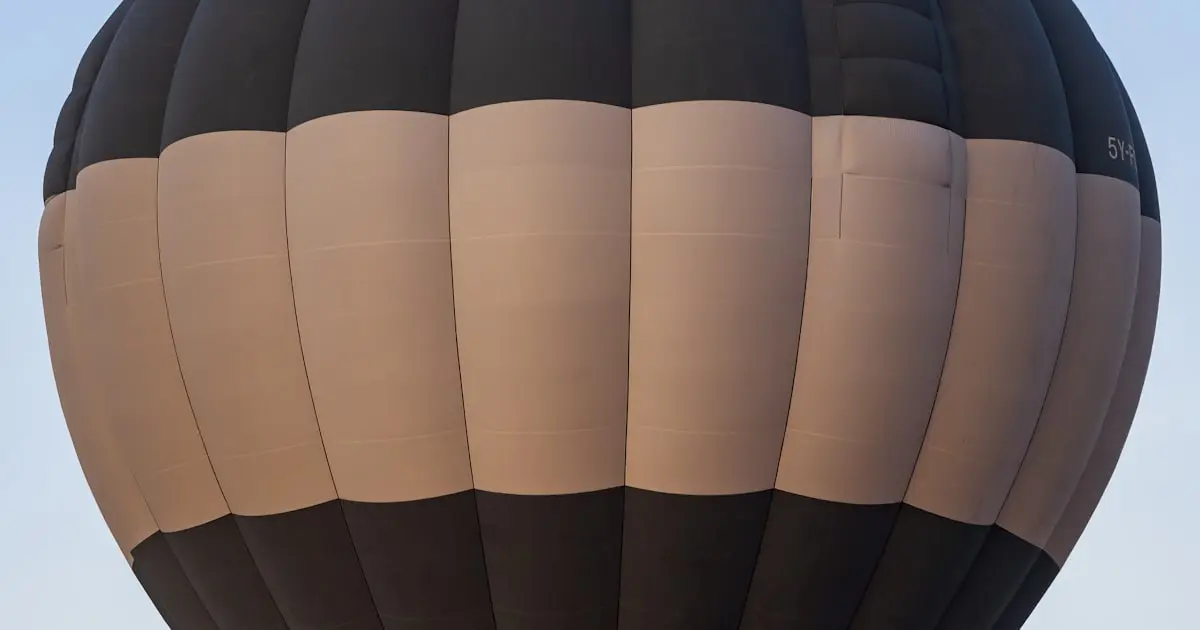
You are standing in the basket. The burner roars overhead. The ground crew lets go of the ropes and the earth begins to fall away beneath you. This is the moment every first-time balloon passenger has been quietly dreading — the moment they find out whether they are going to love this or absolutely hate it.
Here is what almost everyone discovers: it is not scary at all. In fact, it is one of the calmest, most peaceful experiences you will ever have. The fear that builds beforehand almost always evaporates within the first thirty seconds of flight. Let us explore why.
Why Most People Expect to Be Scared
The expectation of fear is completely reasonable. You are stepping into a wicker basket, being lifted hundreds of metres into the air by a bag of hot air, and there is no seatbelt, no door, and no engine to fly you back if something goes wrong. On paper, it sounds terrifying.
Add to that the fact that many people conflate the sensation of height in a balloon with the sensation of height in other contexts — standing on a cliff edge, looking down from a glass walkway, or peering over the railing of a tall building. If those situations make you uncomfortable, you would naturally assume a balloon ride would be worse.
But ballooning is fundamentally different from all of those experiences, and understanding why is the key to understanding why it feels so unexpectedly calm.
Five Reasons Balloon Rides Feel Safe, Not Scary
1. There Is No "Edge" Sensation
The single biggest reason people feel fear at heights is the proximity of an edge — that feeling that one step or one gust of wind could send you over. Your brain perceives the edge as a threat, and your body responds with anxiety, vertigo, or that sickening feeling in the pit of your stomach.
In a hot air balloon basket, there is no edge to fall from. The basket walls are chest-high, made of thick, rigid wicker that feels solid and substantial. You are standing in what is essentially a sturdy, enclosed platform. You would have to deliberately climb over the side to fall, which is something your brain recognises immediately. Within moments of lift-off, the "edge anxiety" that plagues people on observation decks and bridges simply does not activate.
2. The Ascent Is Gradual and Gentle
A balloon does not launch. It does not shoot upward like a rocket or lurch skyward like a lift. It rises. Slowly. Gently. Almost imperceptibly at first.
One moment you are standing on the ground, and the next you notice the grass is a few feet below you. Then the trees are at eye level. Then the rooftops. The transition from ground to sky is so smooth and gradual that your body barely registers it as movement. There is no acceleration, no sudden change, no stomach-dropping sensation.
This gradual ascent gives your brain time to adjust. By the time you are high enough for the view to become dramatic, you have already been airborne for several minutes and your nervous system has accepted the new reality as perfectly normal.
3. The Basket Is Remarkably Stable
People often imagine a balloon basket swinging and swaying beneath the envelope, like a pendulum. In reality, the basket hangs perfectly level and steady. There is no rocking, no tipping, no lateral movement.
This stability exists because the balloon moves with the air mass it is floating in. There is no relative wind hitting the basket from the side, no turbulence buffeting the envelope (at least not during the calm morning conditions when flights take place). The entire system — envelope, basket, passengers, and surrounding air — moves together as one unit. It feels less like flying and more like standing on a very large, very stable platform that happens to be rising.
4. There Is No Wind in Your Face
This surprises nearly everyone. When you imagine flying, you imagine wind — rushing past your face, blowing your hair, creating noise and a sense of speed. In a balloon, there is none of that.
Because a balloon moves at exactly the same speed and direction as the wind, you experience zero relative wind. The air around you is perfectly still. You could light a candle in the basket and the flame would burn straight upward without flickering (between burner blasts, at least). This absence of wind removes one of the sensory cues your brain associates with "high up and exposed," which is another reason the experience feels so serene rather than frightening.
5. No Nearby Reference Points Create a Different Sense of Height
Standing on a 20-storey building and looking down is terrifying partly because the building itself provides a visual reference that emphasises your height. You can see the wall plunging downward, the floors passing beneath you, the ground far below with recognisable objects looking tiny.
In a balloon, there are no nearby vertical reference points. The basket is not attached to a wall or a cliff face. You are simply floating in open space, and the ground below is a landscape — a panorama of fields, villages, and mountains. Your brain processes this more like looking at a map or a photograph than looking down from a dangerous height. The absence of a vertical reference removes the visceral "height panic" that many people experience in buildings or on bridges.
How It Compares to Other Experiences
To put this in context, most balloon passengers report that the experience is:
- Less scary than a glass-floor observation deck — because there is no see-through surface reminding you of the drop
- Far less scary than a roller coaster — because there are no sudden movements, G-forces, or sensations of falling
- Less scary than a tall building balcony — because there is no edge or railing to lean against (or fear leaning too far over)
- Less scary than a glass elevator — because you cannot see the shaft wall rushing past
- More comparable to looking out of an aeroplane window — except quieter, slower, and with no vibration
Many people who describe themselves as "terrified of heights" complete a balloon ride and say it was one of the most peaceful experiences of their lives. Our guide on fear of heights and hot air ballooning goes into much more detail on this topic.
What About Motion Sickness?
Another common concern, and another one that almost never materialises. In a balloon, there is almost no lateral movement and certainly no turning, banking, or acceleration. Your eyes and your inner ear are in perfect agreement: you are floating calmly in space. Motion sickness in a hot air balloon is extremely rare — far rarer than on a boat, a bus, or even a gentle fairground ride.
The Burner Noise: Loud but Not Scary
The one aspect of ballooning that does catch first-timers off guard is the burner. When the pilot fires it, the sound is a deep, powerful roar directly above your head. However, it is a controlled blast lasting only a few seconds, and the pilot fires it at predictable intervals. After the first two or three bursts, you stop noticing it. Between burns, the silence is extraordinary — often the only sound is birdsong from far below.
Tips for Nervous First-Time Riders
If you are still feeling apprehensive, here are some practical tips that can help:
- Tell the pilot. Every good pilot has dealt with nervous passengers hundreds of times. They will keep you informed about what is happening, give you extra reassurance, and position you in the centre of the basket where the walls feel most secure.
- Focus on the horizon, not straight down. Looking out at the panoramic view is much more comfortable than looking directly beneath the basket, at least until you have settled in.
- Bring a companion. Having someone familiar beside you makes a significant difference.
- Trust the statistics. Hot air ballooning has an excellent safety record. This is not a reckless adventure sport — it is a gentle, well-regulated form of sightseeing.
- Read the preparation tips. Our guide to your first balloon ride covers everything you need to know beforehand, which helps reduce anxiety about the unknown.
What If You Feel Anxious Mid-Flight?
On the rare occasion that a passenger does feel uncomfortable during the flight, there are options. The pilot can keep the balloon at a lower altitude. The basket walls provide a solid, reassuring surface to hold onto. And simply closing your eyes for a moment and focusing on the sensation of stillness — the lack of wind, the stability of the basket, the warmth of the sun — can reset your nervous system quickly.
It is also worth knowing that the feeling of anxiety, if it comes at all, almost always passes within the first few minutes. The overwhelming feedback from passengers who were nervous beforehand is: "I cannot believe I nearly talked myself out of this."
What Passengers Actually Say
The reviews from Marrakech balloon passengers tell a remarkably consistent story. The words that come up again and again are "peaceful," "calm," "magical," and "serene." The word "scary" almost never appears — and when it does, it is usually in the context of "I thought it would be scary, but it wasn't."
Many reviewers specifically note that they had a fear of heights and were pleasantly surprised.
Book Your First Flight with Confidence
If you have been putting off a balloon ride because you thought it would be frightening, we hope this article has changed your mind. The reality is simpler than you think: balloon rides are gentle, stable, and overwhelmingly peaceful. The fear is almost always worse than the experience — and the experience is almost always better than you imagined.
A sunrise flight over Marrakech, with the Atlas Mountains on the horizon and the desert catching the first golden light, is one of the most worthwhile things you can do in Morocco. Do not let a fear of the unknown hold you back. Check the schedule, book your flight, and discover for yourself why nearly every passenger steps out of the basket saying the same thing: "That was incredible."
Ready to fly? Compare every hot air balloon Marrakech package and book straight with the operator.