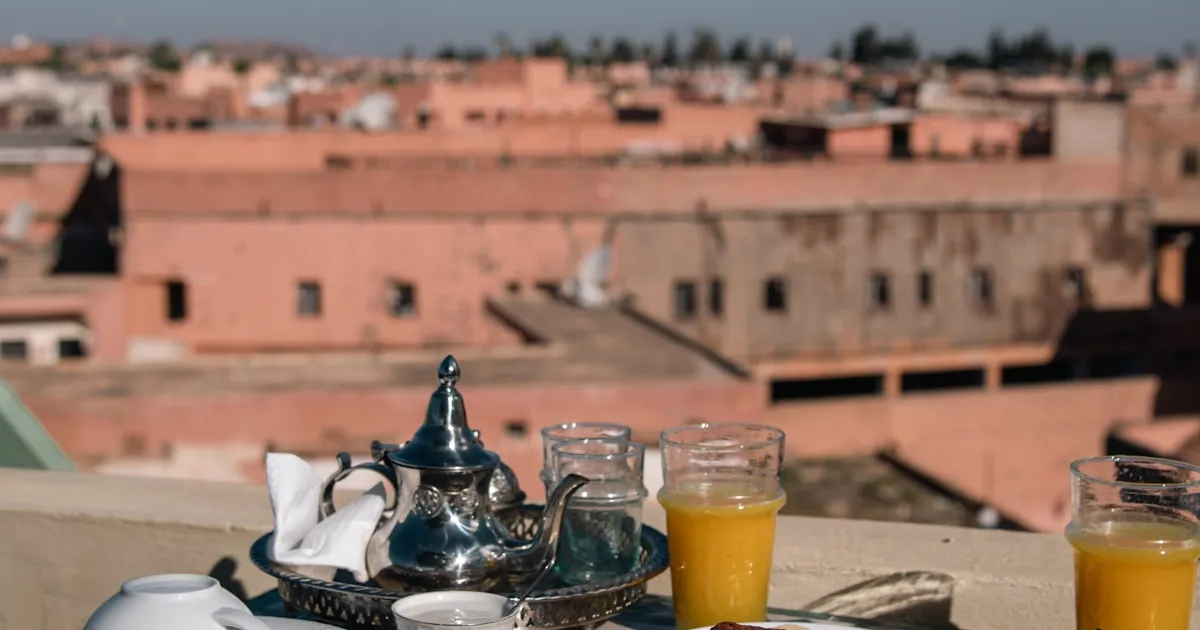
More Than Just a Meal
Every hot air balloon experience in Marrakech ends the same way: with a traditional Berber breakfast served in the open air, usually within sight of the deflating balloons. It is not an afterthought. It is not a granola bar and a bottle of water handed to you in a car park. It is a full, generous, distinctly Moroccan breakfast laid out on low tables with silver teapots, ceramic cups and enough food for twice the number of guests.
This is the part of the morning that surprises people. They expect the flight to be spectacular — and it is. What they do not expect is that sitting on handwoven carpets in a palm grove, drinking sweet mint tea while the morning sun warms the air around them, will feel just as memorable.
The Berber breakfast after your balloon ride is a cultural moment. It is the social wind-down after the intensity of floating 1,000 metres above the Atlas foothills at sunrise. And it is a tradition that has been part of Moroccan ballooning from the very beginning — because in Morocco, no experience is complete without sharing food.
The Setting
Where You Eat
The traditional breakfast after a balloon ride in Marrakech is served outdoors, typically in a palm grove or a desert camp near the landing zone. The exact location varies depending on wind and landing conditions, but the setup follows the same pattern every morning.
Traditional Moroccan carpets and kilim rugs are spread across the ground. Large cushions are arranged around low wooden tables. The tables are set with silver-plated teapots, hand-painted ceramic cups and saucers, and woven baskets holding stacks of fresh bread. It looks — and feels — like you have been invited to a Moroccan family's home.
The Atmosphere
By the time you sit down, the sun has risen above the horizon but the air is still cool from the flight. Temperatures at 6:30 or 7:00 AM in Marrakech range from 12 to 18 degrees Celsius depending on the season — comfortable, pleasant, not yet hot. After spending 45 to 60 minutes at altitude where temperatures can be 5 to 10 degrees lower than ground level, the warmth of the morning sun feels genuinely welcome.
Behind you, the balloon envelopes are being deflated and packed away by the ground crew. The sight of enormous, brightly coloured fabric billowing across the desert floor makes for exceptional photographs — and many guests use this backdrop for group photos and selfies that become the definitive images of their trip.
There is no rush. No one is hurrying you along. The breakfast typically lasts 30 to 45 minutes, and the atmosphere is deliberately unhurried. Guests linger, refill their tea glasses, try one more piece of bread with honey, and simply enjoy the calm.
What Is Served: The Full Spread
A traditional Berber breakfast in Marrakech is bread-centric, generous and varied. Here is what you will find on the table every morning.
Moroccan Mint Tea (Nana)
The centerpiece of any Moroccan meal. The tea is a blend of Chinese gunpowder green tea, fresh spearmint (nana) and sugar — quite a lot of sugar. It is brewed in ornate silver teapots and poured from height into small glasses, creating a thin layer of foam on top. The pouring itself is a performance: the server holds the teapot at arm's length above the glass, a precise stream of tea arcing downward without spilling a drop. This is not showing off. Pouring from height aerates the tea and blends the sugar evenly.
You will be offered multiple glasses. Accept them. In Moroccan culture, refusing tea is considered impolite, and in any case, you will want more.
Msemen and Baghrir
These are the two breads that define a Moroccan breakfast.
Msemen is a flaky, square flatbread made from layers of dough folded with butter or oil, then cooked on a griddle until golden and crisp on the outside, soft and layered inside. Think of it as Morocco's answer to a croissant, but flat and substantially more satisfying. Tear it apart, dip it in honey or olive oil, and you will understand why Moroccans eat it every single morning.
Baghrir — sometimes called "thousand-hole pancakes" — are round, spongy semolina crepes covered in tiny holes on their upper surface. These holes are not decorative. They form naturally during cooking as carbon dioxide escapes through the batter, and they serve a practical purpose: they absorb honey and melted butter like a sponge. A baghrir soaked in warm honey is one of the great simple pleasures of Moroccan cuisine.
Khobz (Fresh Baked Bread)
Round, dense, slightly crusty Moroccan bread baked fresh that morning. Khobz is the foundation of every meal in Morocco — breakfast, lunch and dinner. It is used as a utensil, torn into pieces and used to scoop up olive oil, honey, soft cheese or amlou. At the balloon breakfast, it arrives warm, often still steaming.
Local Honey
The Marrakech region produces some of Morocco's most distinctive honeys. Wild thyme honey from the Atlas foothills is amber-coloured, thick and intensely floral. Orange blossom honey, lighter and more delicate, comes from the citrus groves of the Haouz plain surrounding the city. Both are typically available at the breakfast table, served in small ceramic dishes for drizzling over bread and baghrir.
Moroccan honey is not pasteurised or mass-produced. What you taste at the balloon breakfast is local, seasonal and genuinely different from anything in a supermarket jar.
Moroccan Olive Oil
Pressed from the small, dark olives that grow throughout the Marrakech-Safi region. Moroccan olive oil tends to be robust and slightly peppery — different from the milder Italian or Spanish oils most visitors are accustomed to. It is served in small dishes alongside the bread, and the traditional way to eat it is to pour a pool of oil onto a plate, add a pinch of salt, and dip torn pieces of khobz into it.
Amlou
This is the item on the breakfast table that most visitors have never encountered before — and the one they most frequently ask about afterwards.
Amlou is a thick paste made from roasted almonds, argan oil and honey, ground together until smooth. It is unique to Morocco, specifically to the regions where argan trees grow (the Souss-Massa area south of Marrakech). The flavour is rich, nutty and sweet, somewhere between peanut butter and praline but more complex than either. It is spread on bread or msemen, and it is genuinely addictive.
If you buy one food item to bring home from Morocco, make it a jar of amlou.
Soft Cheese and Cream Cheese
Jben is a fresh, soft Moroccan cheese similar to ricotta or fresh chevre. It is mild, slightly tangy and pairs well with honey or olive oil on bread. Cream cheese (fromage frais) is also typically available. Neither is strong or pungent — they are mild, fresh dairy products that balance the sweetness of the honey and pastries.
Fresh Fruit
Oranges are the constant. Morocco is one of the world's largest orange producers, and the fruit available in Marrakech — particularly the navel oranges from the Souss region — is sweeter and more flavourful than what most European or North American visitors are used to. Depending on the season, you may also find clementines, pomegranates, figs, dates or melon.
Pastries, Eggs and Extras
The spread typically also includes:
- Almond-filled pastries — small, crescent-shaped pastries filled with ground almond paste and dusted with icing sugar
- Croissants and pain au chocolat — Morocco's French colonial heritage shows up at the breakfast table
- Hard-boiled eggs — peeled and halved, with salt and cumin for dipping
- Butter and assorted jams — fig jam and apricot jam are the most common, both often homemade
The Cultural Significance
Breakfast Is Communal
In Morocco, breakfast is not something you eat alone at a kitchen counter. It is shared. The food is placed in the centre of the table and everyone reaches in — tearing bread from the same loaf, pouring tea for each other, passing dishes back and forth. This communal style is deliberate. It reflects a core principle of Moroccan (and specifically Berber) culture: generosity expressed through abundance.
The amount of food at a Moroccan breakfast always exceeds what the guests can eat. This is not waste — it is hospitality. Providing more than enough is a way of honouring your guests. At the balloon breakfast, this tradition is upheld faithfully. The table is always full.
The Mint Tea Ceremony
The way mint tea is prepared and served in Morocco carries real cultural weight. Tea is offered to every guest as a sign of welcome. The host (or server) pours the first glass, tastes it, pours it back into the pot, adjusts the sugar, and repeats until the flavour is correct. Then the tea is poured from height — a skill that takes genuine practice — into small glasses that are never more than two-thirds full.
You will typically be offered three glasses. There is a Moroccan saying: "The first glass is as gentle as life, the second is as strong as love, the third is as bitter as death." In practice, all three taste the same because they come from the same pot. But the sentiment captures the importance of tea in Moroccan social life — it is not just a drink, it is a ritual of connection.
Bread at the Centre
In Moroccan culture, bread has an almost sacred status. It is never thrown away. If a piece of bread falls on the ground, it is picked up, kissed and placed somewhere elevated. Bread is used as cutlery — forks are unnecessary when you have khobz. At the balloon breakfast, the centrality of bread is immediately obvious: there are at least three types on the table, all fresh, all warm, and all disappearing fast.
Berber Hospitality
The Berber (Amazigh) people of the Atlas Mountains and surrounding regions are renowned throughout North Africa for their hospitality traditions. A guest is considered sacred — "the guest of God," as the expression goes. Offering food, tea and comfort to visitors is not optional; it is a moral obligation. The balloon breakfast is a direct expression of this tradition, scaled up for tourists but rooted in the same values. The abundance, the warmth, the unhurried pace — these are not marketing decisions. They are cultural ones.
The VIP Difference: Breakfast at Altitude
On the VIP Flight, everything changes. The traditional Berber breakfast is not served after landing — it is served on board the balloon, at altitude, while you are still floating above the landscape.
A small table is set up inside the basket with a selection of the same traditional items: mint tea, msemen, bread, honey, olive oil and pastries. You eat breakfast while looking down at the palm groves, the Berber villages and the Atlas Mountains spread across the horizon. The pilot maintains a stable altitude while you eat, and the burner fires are less frequent to preserve the quiet.
It is, without exaggeration, one of the most unusual breakfast settings on earth. The combination of fresh Moroccan food, absolute silence (between burner blasts), panoramic views and the gentle rocking of the basket is unlike anything most people have experienced. If you are celebrating a special occasion — an anniversary, a proposal, a milestone birthday — the VIP breakfast at altitude is the version that creates lifelong memories.
For details and pricing, see our VIP Flight page.
Dietary Considerations
The traditional Berber breakfast is naturally accommodating, but it is worth knowing the specifics before you fly.
Vegetarian-friendly. The entire spread is vegetarian by default. There is no meat served at the balloon breakfast. Eggs, cheese, bread, fruit, honey, olive oil — all vegetarian.
Vegan options. Bread (khobz and msemen), olive oil, fresh fruit and mint tea are vegan. Honey, butter, cheese and amlou (contains honey) are not. You will not go hungry, but the options are more limited.
Gluten-free. This is the main limitation. The breakfast is heavily bread-based, and msemen, baghrir and khobz all contain wheat or semolina. However, hard-boiled eggs, fresh fruit, honey, olive oil and cheese are all naturally gluten-free. You will have enough to eat, but the star items (the breads) will be off-limits.
Nut allergies. Amlou contains almonds and must be avoided if you have a tree nut allergy. The almond pastries are also a concern. Notify us when booking so we can ensure these items are flagged or separated at the table.
Halal. The entire breakfast is halal by default. All ingredients are sourced locally from halal-certified suppliers.
Lactose intolerance. Jben and cream cheese contain dairy. Butter is used in some pastries. The breads, honey, olive oil, fruit and tea are all dairy-free.
If you have specific dietary requirements, mention them when you book. We prepare the breakfast fresh each morning and can make adjustments with advance notice.
Photo Opportunities
The breakfast setting produces some of the best photographs of the entire balloon experience. Here is what to look for:
- The table spread. A low table loaded with colourful Moroccan ceramics, silver teapots, stacked breads and small dishes of honey and olive oil, all set against a desert or palm grove backdrop. This is the shot that performs well on social media.
- The tea pour. Ask your server to pour tea while you photograph — the arc of tea from the raised teapot into a small glass is visually striking and distinctly Moroccan.
- The balloon backdrop. As you eat, the ground crew is deflating and packing the balloon envelopes behind you. The partially deflated balloons, spread across the ground in vivid colours, create an unmistakable background for group photos.
- The morning light. At 7:00 AM in Marrakech, the light is golden and warm — ideal for portraits and food photography. Harsh shadows have not yet developed, and the low angle of the sun creates depth and texture in every shot.
Keep your phone or camera accessible during breakfast. Some of the most natural, relaxed and genuinely joyful photos from the experience come from this part of the morning, not the flight itself.
How the Breakfast Fits Into Your Morning
The full timeline of a balloon ride morning looks like this:
- 5:00-5:30 AM: Hotel pickup by 4x4
- 6:00 AM: Arrive at launch site, watch balloon inflation
- 6:15-6:30 AM: Take off at sunrise
- 7:00-7:15 AM: Land after 45-60 minutes of flight
- 7:15-8:00 AM: Traditional Berber breakfast (30-45 minutes)
- 8:30-9:00 AM: Return to hotel
The breakfast occupies roughly 30 to 45 minutes. No one is watching the clock. Some guests finish quickly and spend the remaining time taking photos. Others sit for the full duration, drinking three or four glasses of mint tea and working their way through every item on the table. There is no wrong approach.
By 9:00 AM, you are back at your hotel with the entire day ahead of you. The early start, which seemed brutal at 5:00 AM, now looks like the best decision you made all week. You have floated above the Atlas Mountains at sunrise, eaten a traditional Moroccan breakfast in a palm grove, and it is still not even mid-morning.
Book Your Flight
The traditional Berber breakfast is included in every flight we offer — there is no additional charge.
The Classic Flight at 1,700 Dhs per person includes the full breakfast experience on the ground after landing. For something extraordinary, the VIP Flight serves breakfast on board the balloon at altitude — an experience available nowhere else in Marrakech.
Not sure which flight is right for you? Our comparison of private vs. shared flights breaks down the options. And if you are still in the planning stages, our complete trip planning guide covers everything from booking to what to wear.
The balloon lifts off at sunrise. The breakfast is waiting when you land. All you need to do is book your flight and set an alarm.