
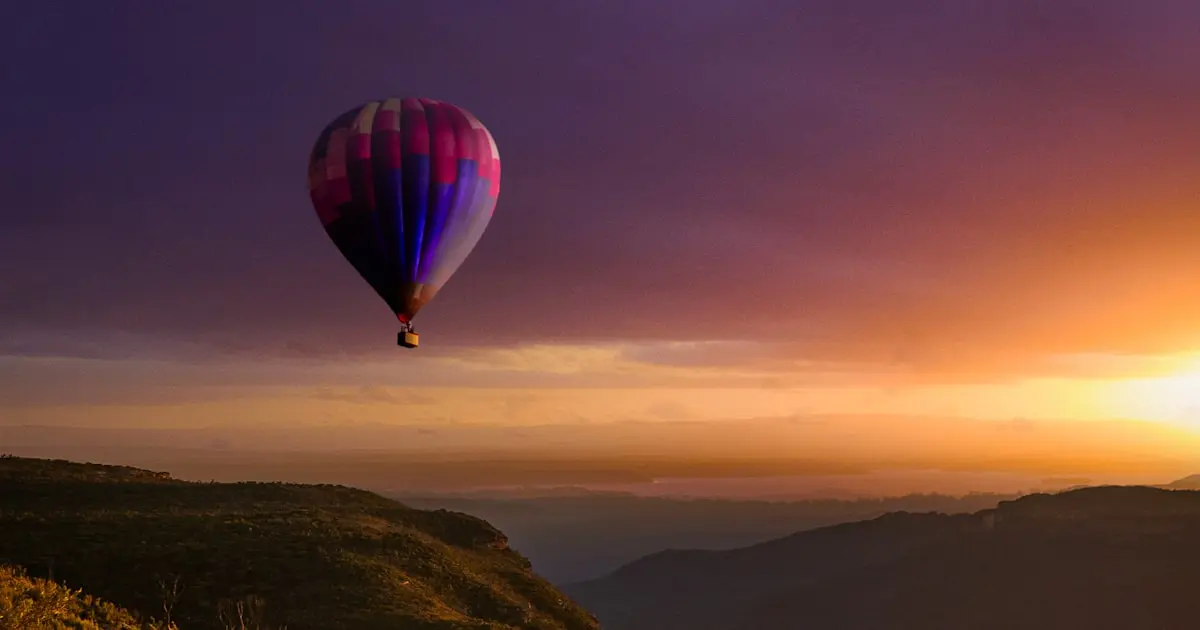
If you have ever watched a hot air balloon drifting silently across a dawn sky and wondered whether the same experience could happen under the stars, you are not alone. The idea of floating above a moonlit landscape is undeniably romantic. But can hot air balloons actually fly at night? The short answer is: technically yes, but commercially, almost never. Here is everything you need to know about why that is, what night glow events are, and why sunrise remains the gold standard for ballooning.
The Technical Answer: Yes, Balloons Can Fly at Night
There is nothing about the physics of hot air ballooning that prevents flight after dark. The burner still heats the air inside the envelope, the balloon still generates lift, and the pilot can still control altitude. The fundamental mechanics described in our guide on how hot air balloons work apply regardless of the time of day.
In fact, some of the earliest balloon flights in history took place at various times of day, and military observation balloons were occasionally deployed at night during wartime operations. So the technology itself is not the limiting factor.
Why Commercial Balloon Flights Almost Never Happen at Night
Despite being technically possible, night-time balloon flights are extraordinarily rare in the commercial world. There are several compelling reasons for this.
Reduced Visibility and Terrain Reading
A hot air balloon pilot's most critical skill is reading the terrain below. During flight, the pilot must constantly assess potential landing sites, identify obstacles such as power lines and trees, and monitor the ground for hazards. At night, this becomes extremely difficult, even with artificial lighting.
Unlike an aeroplane flying at high altitude along charted airways, a balloon operates at low altitude over varied terrain. The pilot needs to see what is directly below and ahead — fences, livestock, rocky ground, bodies of water — to select a safe landing spot. In darkness, even with moonlight, these details become invisible until it is far too late.
Wind Behaviour After Dark
One of the key reasons sunrise flights are preferred is that early morning air is calm and predictable. After sunset, wind patterns can become erratic. Nocturnal temperature inversions, katabatic winds flowing down hillsides, and unpredictable gusts near the surface all make night flying considerably more hazardous.
While experienced meteorologists can forecast night-time conditions, the margin for error is much thinner than during the settled conditions of early morning.
Regulatory Requirements
Aviation authorities worldwide impose strict requirements on night balloon flights. In the United States, the Federal Aviation Administration (FAA) requires balloons flying at night to carry navigation lights visible from several miles away, including a white anti-collision light and position lights. The pilot must also hold specific night-flying endorsements and carry additional instruments.
In Europe and many other jurisdictions, the requirements are similarly stringent. The balloon must be equipped with an altimeter, a rate-of-climb indicator, and often a transponder — equipment that most commercial sightseeing balloons simply do not carry because they have no reason to.
Insurance and Liability
Even if a commercial operator wanted to offer night flights and had the necessary equipment and certifications, insurance companies would likely charge prohibitively high premiums. The increased risk profile of night operations makes it financially impractical for operators whose business model relies on safe, repeatable passenger flights.
Night Glow Events: The Spectacular Alternative
If balloons rarely fly at night, how do we explain those stunning photographs of illuminated balloons glowing against a dark sky? The answer is the night glow — one of the most beloved events at balloon festivals worldwide.
What Is a Night Glow?
A night glow (sometimes called a balloon glow or a nightglow) is an event where multiple hot air balloons are inflated and tethered to the ground after dark. On cue, the pilots fire their burners simultaneously, causing the envelopes to light up like enormous lanterns. The effect is breathtaking — dozens of glowing orbs pulsing with warm light against the night sky.
The key word here is tethered. The balloons are firmly anchored to the ground. They are not flying. This eliminates the landing hazards and navigation challenges that make night free flight so problematic.
Where to See Night Glows
Night glow events happen at balloon festivals around the world. Some of the most famous include:
- Albuquerque International Balloon Fiesta (New Mexico, USA) — The world's largest balloon event, with mass ascensions and spectacular evening glows featuring hundreds of balloons
- Bristol International Balloon Fiesta (England) — The UK's largest annual balloon event, held every August with a famous nightglow set to music
- Canberra Balloon Spectacular (Australia) — Features occasional evening glow events alongside its famous morning flights over Parliament House
- Cappadocia Balloon Festival (Turkey) — Combining the region's otherworldly landscape with illuminated balloons
- Taiwan International Balloon Festival (Taitung) — Known for its colourful glows against mountain backdrops
Many smaller regional festivals also feature night glows. They are often the highlight of the programme, attracting thousands of spectators who may not attend the early-morning flights.
Night Glows and Music
What makes night glows truly magical is that they are often choreographed to music. The pilots coordinate their burner blasts to match the beat, creating a synchronised light show. The hiss of the burners, the pulsing glow of the envelopes, and the backdrop of a darkening sky combine to create an atmosphere that is genuinely unforgettable.
Why Sunrise Is the Gold Standard
If you are booking a hot air balloon ride — whether in Marrakech, Cappadocia, or anywhere else — your flight will almost certainly depart at sunrise. And once you understand why, you will be glad it does.
Stable, Calm Air
In the first hour after dawn, the atmosphere is at its most settled. The sun has not yet had time to heat the ground, which means there are no thermals — those rising columns of warm air that create turbulence later in the day. This makes for a smooth, peaceful flight. Our detailed look at why balloon rides happen in the morning covers the science behind this in depth.
Maximum Lift Efficiency
Cool morning air is denser than warm afternoon air. This means the temperature difference between the heated air inside the balloon and the cooler air outside is at its greatest, giving the balloon maximum lift efficiency. The pilot has more precise control over altitude, and the balloon responds more predictably to burner inputs.
Unbeatable Light and Photography
The golden hour — that window of warm, soft light just after sunrise — is every photographer's dream. During a sunrise balloon flight over Marrakech, the Atlas Mountains glow pink and gold, the desert floor is painted in long shadows, and the sky shifts through a palette of colours that no filter can replicate. This is not just a nice bonus; for many passengers, the visual spectacle is the entire point of the experience.
Safety Margins
With a full day of daylight ahead, a sunrise departure gives the pilot maximum flexibility. If conditions change or the flight takes longer than expected, there is no risk of running out of light. The retrieve crew can easily spot the balloon and reach the landing site on clear, visible roads.
What About Evening Flights?
Some locations do offer late afternoon or sunset flights. These take advantage of the second calm window that often occurs as the sun drops low and surface heating decreases. In places like the Napa Valley in California or parts of southern France, evening flights are popular.
However, evening flights have a shorter weather window than morning flights. The pilot must time the departure precisely to catch the period of calm before sunset, and the flight must end before dusk. If conditions are not right within that narrow window, the flight is cancelled. This is why morning flights are more reliable and why most operators — including those in Marrakech — stick to dawn departures.
You can learn more about what happens when weather forces a cancellation in our guide on what to do if your balloon ride is cancelled.
The Marrakech Sunrise Experience
In Marrakech, the combination of dry desert air, predictable morning conditions, and the stunning backdrop of the Atlas Mountains makes sunrise the perfect — and only — time to fly. Passengers are typically collected from their hotel between 5:00 and 6:00 AM, arriving at the launch site as the first light appears on the horizon.
The early wake-up might feel challenging, but every passenger who has watched the sun rise from 1,000 feet above the Moroccan landscape will tell you the same thing: it was worth every minute of lost sleep. The reviews from past passengers speak for themselves.
In Summary
Hot air balloons can fly at night in theory, but the combination of reduced visibility, unpredictable winds, regulatory hurdles, and safety concerns means that night flights are almost unheard of in commercial ballooning. If you want to see balloons after dark, a night glow event at a balloon festival is your best option — and it is genuinely spectacular.
For the actual flying experience, sunrise is not just the default — it is the best. The calm air, the efficient lift, the extraordinary light, and the unmatched sense of peace make dawn flights something truly special.
Ready to Experience a Sunrise Flight?
There is nothing quite like watching the sun rise from the basket of a hot air balloon above Marrakech. The Atlas Mountains catching the first light, the vast desert stretching to the horizon, the silence broken only by the occasional burst of the burner — it is an experience that stays with you.
Check our schedule and availability and find out why a Marrakech balloon ride is worth every dirham. Book your sunrise flight today and see Morocco from a perspective few ever will.
Want to go up? Browse every Marrakech hot air balloon option and pick the one that suits your trip.