
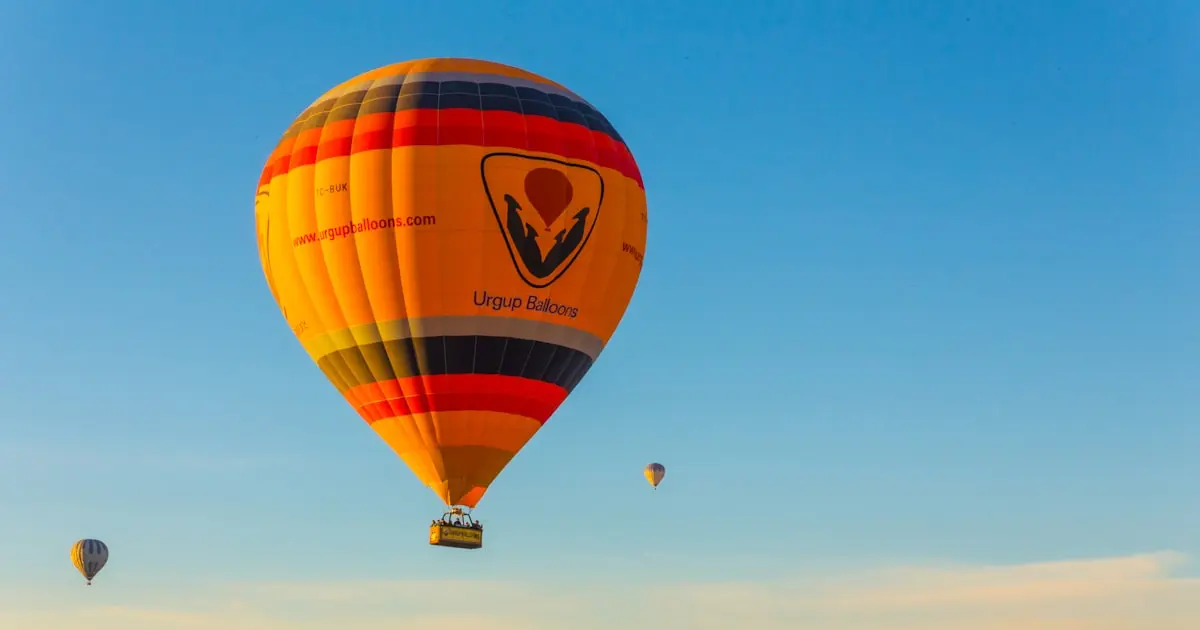
The question sounds like something from a dare: can you actually jump out of a hot air balloon with a parachute? The answer is yes — and not only is it possible, it is a well-established niche within the skydiving world. Balloon skydiving, sometimes called "balloon jumping," offers an experience that is fundamentally different from jumping out of an aeroplane, and many experienced skydivers consider it one of the purest forms of freefall.
Here is everything you need to know about how it works, where you can do it, and why it feels so different from a standard skydive.
How Balloon Skydiving Works
The basic concept is straightforward: a hot air balloon climbs to jump altitude with skydivers on board, the skydivers exit the basket, freefall, and deploy their parachutes. But the execution involves some unique considerations that set it apart from aircraft-based skydiving.
The Ascent
The first difference is the journey up. In a conventional skydive, you sit in a noisy turboprop aircraft for 15 to 20 minutes, climbing rapidly to altitude. The cabin vibrates, the engine drones, and conversation is difficult.
In a balloon, the ascent is silent. You stand in an open basket, watching the ground fall away beneath you with no engine noise, no vibration, and no rush. The balloon climbs at approximately 300 to 500 metres per minute — considerably slower than an aircraft — so reaching jump altitude can take 20 to 30 minutes or more. This extended, peaceful ascent gives jumpers time to take in the view, mentally prepare, and appreciate the sheer height they are about to leap from.
Jump Altitude
For standard balloon skydives, the balloon typically climbs to between 3,000 and 4,500 metres (approximately 10,000 to 15,000 feet). This is comparable to the exit altitude for most tandem and sport skydives from aircraft.
Some specialist balloon jumps go higher, up to 6,000 metres (20,000 feet) or beyond, though these require supplemental oxygen and more specialised equipment.
The Exit
This is where balloon jumping diverges most dramatically from aeroplane skydiving. When you jump from an aircraft travelling at 150 kilometres per hour, you exit into a blast of wind and immediately begin moving forward as well as downward. The relative wind hits you horizontally, and you adopt a belly-to-earth position to stabilise.
When you step off the edge of a balloon basket, there is no forward speed. The balloon is stationary relative to the air around it (because it moves with the wind, as explained in our guide on how balloons are steered). You simply fall. Straight down.
The first two to three seconds of a balloon jump are unlike anything in conventional skydiving. There is no wind blast, no tumbling from the aircraft's slipstream, just pure, silent, vertical freefall. You can look up and see the basket of the balloon directly above you, growing smaller. It is an eerily quiet, almost surreal moment that skydivers describe as profoundly different from any other type of jump.
Building Airspeed
After those first few seconds of near-silence, gravity does its work. You accelerate rapidly, and within about 10 to 12 seconds you reach terminal velocity — approximately 200 kilometres per hour in the belly-to-earth position. At this point, the experience becomes similar to a conventional freefall: the wind roars, you stabilise in your chosen body position, and you have roughly 40 to 60 seconds of freefall before deploying your parachute.
The total freefall time depends on exit altitude and deployment altitude, just as with any skydive. From 4,000 metres, a belly-to-earth freefall to deployment at 1,500 metres gives approximately 40 seconds of freefall.
How It Differs from Plane Skydiving
Experienced skydivers who have jumped from both platforms consistently highlight several key differences:
True Vertical Freefall
The absence of forward airspeed means the initial freefall is genuinely vertical. In aircraft skydiving, the horizontal component of your exit speed means you follow a curved trajectory until air resistance cancels the forward momentum. From a balloon, you drop straight down. This creates a unique visual perspective — looking up to see the balloon directly above you, rather than behind and to one side.
The Silent Exit
Many jumpers describe the balloon exit as the most memorable part of the experience. The transition from absolute silence in the basket to the rush of freefall is stark and powerful. There is no aircraft noise to mask the moment of departure. You hear your own breathing, the creak of the basket, and then nothing but the building wind.
A More Contemplative Experience
The slow ascent, the open basket, the panoramic views, and the quiet atmosphere create a meditative quality that aircraft skydiving simply cannot replicate. Several jumpers describe balloon jumping as more emotional and more personally meaningful than their typical plane jumps.
Visual Reference
Looking up during the initial freefall and seeing the balloon basket above you — a small rectangle against the sky — is a visual that is unique to balloon jumping. In an aircraft jump, the plane is already hundreds of metres away by the time you stabilise in freefall.
Where Can You Do It?
Balloon skydiving is a niche activity offered by specialist operators, not a standard product at every drop zone. You will find it available in several countries:
- United States — Several drop zones across the US offer balloon jumps, particularly in states with strong ballooning traditions like New Mexico and California
- United Kingdom — A handful of British skydiving centres arrange balloon jumps, though weather constraints mean availability is limited to summer months
- France — Some French drop zones near ballooning regions offer combined experiences
- Netherlands — The flat terrain and active ballooning scene make this a natural location for balloon jumps
- Switzerland — Alpine balloon jumps are available for experienced skydivers, offering spectacular mountain scenery
Availability varies by season and weather, and advance booking is typically required. Many operators run balloon jump events on specific dates rather than offering them daily.
What Does It Cost?
Balloon skydiving is more expensive than a standard aircraft skydive. A typical tandem skydive from an aircraft costs between 200 and 300 euros in most European countries. A balloon jump typically costs between 300 and 500 euros, and in some locations considerably more.
The higher cost reflects balloon hire, slower turnaround times (the balloon must be retrieved and re-inflated), limited basket capacity, and greater weather dependency. Most skydivers who have done both agree the premium is justified by the unique nature of the experience.
Tandem balloon skydives are also available at some locations, making the experience accessible to first-time jumpers. However, they are less widely offered than tandem aircraft jumps due to the limited capacity of the balloon basket.
Famous Balloon Jumps
Balloon skydiving has a rich history, including some of the most extraordinary human achievements in aviation:
Felix Baumgartner — Red Bull Stratos (2012)
On 14 October 2012, Austrian skydiver Felix Baumgartner ascended to 38,969 metres (127,852 feet) — the edge of space — in a pressurised capsule carried by a helium balloon. He stepped out and fell for 4 minutes and 19 seconds, reaching a maximum speed of 1,357.64 kilometres per hour — breaking the sound barrier with his body. He became the first person to go supersonic outside a vehicle.
The jump was watched live by millions worldwide and remains one of the most watched events in internet history. While technically a stratospheric helium balloon jump rather than a hot air balloon jump, it demonstrated the extraordinary potential of balloon-based skydiving.
Alan Eustace (2014)
Just two years later, Google executive Alan Eustace quietly broke Baumgartner's altitude record. On 24 October 2014, Eustace ascended to 41,425 metres (135,890 feet) beneath a helium balloon, wearing a specially designed pressure suit. He released from the balloon and fell for 4 minutes and 27 seconds, reaching a maximum speed of 1,322 kilometres per hour.
Unlike Baumgartner's heavily publicised jump, Eustace's record was set with minimal fanfare — he simply wanted to see the curvature of the Earth.
Jacques Garnerin (1797)
The very first parachute jump from a balloon was made by French aeronaut Jacques Garnerin on 22 October 1797 in Paris. He ascended to approximately 900 metres in a hydrogen balloon and released himself in a frameless parachute — making balloon skydiving, in a sense, the oldest form of parachuting.
Do Regular Hot Air Balloons Have Parachutes?
A common question from sightseeing passengers is whether balloons carry parachutes. The answer is no — and for good reason. A hot air balloon envelope is, in effect, a very large, very slow parachute. Even with a complete burner failure, the air inside cools gradually and the balloon descends slowly. The pilot can still vent air to control descent rate and adjust altitude to find different wind directions. Commercial balloons also carry dual burner systems for redundancy. Individual parachutes would be impractical — untrained passengers attempting to jump from a slowly descending balloon would be at far greater risk than simply remaining in the basket. Our article on how high balloons can go provides more context on commercial flight altitudes.
Alternative Thrills in Marrakech
While Marrakech does not currently offer balloon skydiving, the region provides plenty of adventure experiences that complement a traditional sunrise balloon flight. Many visitors combine their balloon ride with:
- Quad biking in the Agafay Desert — high-speed desert driving through dramatic rocky terrain
- Camel rides at sunset — a more traditional way to experience the desert landscape
- Atlas Mountain excursions — hiking, mule trekking, and village visits in the High Atlas
- Desert buggy tours — off-road adventures through the palmeries and dry riverbeds
Our guide to Marrakech adventure combos covers the best ways to pair your balloon flight with other activities for an unforgettable day.
Experience the Balloon Ride Itself
Whether or not you add a parachute to the equation, a hot air balloon ride in Marrakech — floating in a wicker basket above the Moroccan landscape at dawn — is extraordinary in its own right. The silence, the space, the slowly unfolding panorama of the Atlas Mountains — it is an experience that stays with you.
For first-time balloon riders, our shared Classic sunrise flight provides more than enough excitement and wonder. Check the schedule and availability, reserve your date, and discover why a Marrakech balloon ride is one of the most worthwhile experiences in Morocco.
Want to go up? Browse every Marrakech hot air balloon option and pick the one that suits your trip.