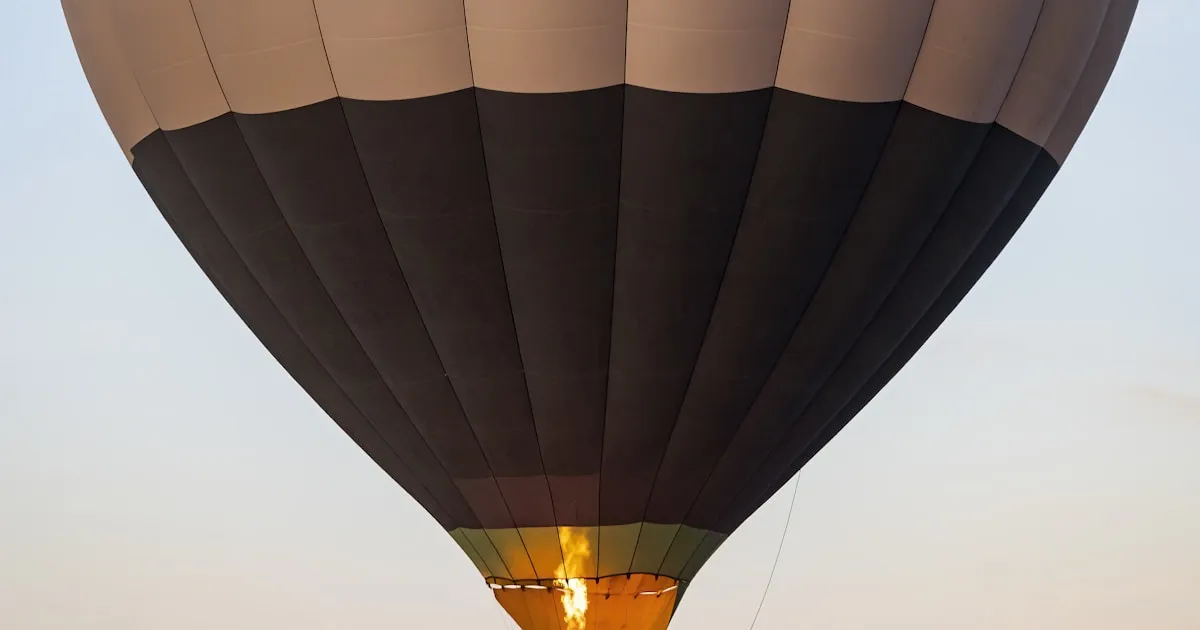
You Are Not the First Person to Google This
If you have typed "fear of heights hot air balloon" into a search bar, you are in excellent company. A significant percentage of our passengers describe themselves as nervous about heights before their flight. Some are mildly uncomfortable. Others are genuinely scared. A handful have told us they almost cancelled.
Here is what happens in practice: the vast majority of those nervous passengers land with a grin on their face. Many describe the flight as the highlight of their trip. And a striking number say some variation of the same sentence: "It was nothing like I expected."
This article explains why balloon flights feel fundamentally different from other height experiences, what actually triggers acrophobia, and how you can manage anxiety if you decide to fly. We will also be honest about the cases where a balloon ride might not be the right choice.
Why Balloon Rides Feel Different from Other Heights
Think about the situations that trigger your fear of heights. Standing on a balcony and looking down. Peering over the edge of a cliff. A glass-floored observation deck. A ferris wheel swinging in the wind. A narrow mountain path with a sheer drop to one side.
Every one of those scenarios shares a common feature: there is a fixed reference point nearby that tells your brain exactly how high you are and exactly how far you could fall. The railing you are gripping, the cliff edge beneath your feet, the building you are standing on — your brain uses these objects to calculate danger.
A hot air balloon removes all of those triggers. There is no edge. There is no cliff. There is no swaying structure bolted to the side of a building. You are standing inside a waist-high wicker basket, surrounded on all sides, floating in open air with nothing nearby to create that sickening sense of relative height.
This distinction is critical, and it is why people who cannot stand on a third-floor balcony frequently report feeling completely calm at 500 metres in a balloon.
The Science Behind It: What Actually Triggers Acrophobia
Acrophobia — the clinical term for fear of heights — is not simply a response to being high up. Research in visual perception and spatial orientation shows that the fear response is triggered by specific visual cues, particularly the relationship between your body and nearby fixed objects at height.
When you stand on a tall building and look down, your visual system processes the distance between you and the ground, the proximity of the edge, and the relative scale of objects below compared to the structure you are standing on. Your brain interprets this combination of inputs as danger and activates a fear response: increased heart rate, sweating, dizziness, the urge to step back or grip something.
In a balloon, these visual inputs are fundamentally altered. The ground does not drop away suddenly — it recedes gradually, centimetre by centimetre, as you ascend at roughly 1 to 2 metres per second. There is no nearby structure to provide a height reference. The buildings, trees and roads below shrink so slowly that your brain does not register a threatening change. For many people with acrophobia, the result is a complete absence of the usual fear response.
This is also why balloons feel different from aeroplanes. In a plane, you climb rapidly, you can see the ground dropping away through a small window, and the aircraft itself — the seat, the walls, the wing — provides a constant fixed reference that reminds your brain you are inside a machine at altitude. A balloon has none of that. You are standing in open air, moving with the atmosphere, and your visual field is dominated by sky and horizon rather than by nearby objects at height.
The Basket Factor: More Enclosed Than You Think
One of the most common concerns from nervous passengers is the basket. They picture themselves standing in a flimsy container with low sides, exposed to the open air, with nothing between them and a long drop.
The reality is quite different. A standard balloon basket has walls that reach waist height on most adults — roughly 1.1 to 1.2 metres. The walls are solid wicker, reinforced with steel cables and leather padding along the top edge. You cannot accidentally lean over and fall. You cannot slip through a gap. The interior is divided into compartments, so you are standing in a defined, enclosed space with walls on multiple sides.
Most passengers tell us the basket feels more secure than they anticipated. Several have compared it to standing in a large, sturdy box. The sensation is of being inside something, not on top of something — and that distinction makes an enormous psychological difference for people who are scared of heights during a balloon ride.
The Gradual Ascent: You Barely Notice Leaving the Ground
If you are picturing a dramatic launch — a sudden lurch upward, the ground falling away beneath you — set that image aside. A hot air balloon ascent is one of the gentlest transitions in aviation.
The pilot heats the air inside the envelope, and the balloon becomes buoyant. You rise at approximately 1 to 2 metres per second. To put that in perspective, a standard lift in a hotel moves at 1 to 3 metres per second. The difference is that in a lift, you feel the acceleration in your stomach. In a balloon, you feel nothing at all.
Many passengers do not even register the exact moment they leave the ground. The basket lifts, the grass drops a few centimetres below your feet, and you are airborne — but the transition is so smooth that it simply does not trigger the physical anxiety response that a sudden change in height would produce.
By the time you look around and realise you are 50 metres up, you have already been ascending for nearly a minute. Your brain has had time to adjust incrementally rather than being confronted with a sudden, frightening change.
Zero Sense of Motion: The Factor Nobody Expects
This is perhaps the single most important reason why people with acrophobia find balloon flights comfortable, and it is also the hardest to convey in writing.
In a hot air balloon, you have no sensation of movement. None. You do not feel wind in your face. You do not feel swaying. You do not feel acceleration or deceleration. You are moving — typically at 10 to 20 kilometres per hour — but because you are travelling with the wind rather than through it, there is no relative airflow against your body.
Compare this with every other height experience that triggers fear:
- Ferris wheels sway, rock, and you feel the rotation
- Observation decks transmit the building's movement in wind
- Aeroplanes have turbulence, engine vibration, and visible motion through windows
- Cable cars swing and bounce on the cable
- Bridges flex and vibrate underfoot
A balloon eliminates all of these motion cues. You are standing on a stable platform that moves in perfect synchronisation with the air around it. The silence between burner blasts is remarkable — you can hear birds, dogs barking in villages below, even conversations on the ground. That silence, combined with the total absence of motion, creates a sensation that most passengers describe as "floating" rather than "flying." And floating, it turns out, is not frightening.
What Nervous Passengers Actually Say
We have flown thousands of passengers who told us beforehand that they were nervous about heights. The feedback falls into remarkably consistent patterns.
The first 2 to 5 minutes are the adjustment period. Most nervous passengers grip the basket edge during the initial ascent, stay toward the centre, and keep their eyes on the horizon. This is completely normal and exactly what we recommend. Within 5 minutes, the vast majority have relaxed visibly. They start looking down. They take out their phones. They smile.
"I forgot I was scared." This phrase, or close variations of it, comes up constantly. The beauty of the sunrise, the scale of the Atlas Mountains, the patchwork of palm groves and villages below — the visual experience is so absorbing that it overrides the anxiety. Your attention shifts from "I am high up" to "this is extraordinary."
"It felt like standing on solid ground." The stability of the basket, combined with the absence of motion, leads many passengers to say they genuinely forgot they were in the air. One guest told us: "If you had blindfolded me, I would not have known I was 300 metres up."
"I would do it again." This is the response that matters most. Passengers who were genuinely frightened before the flight routinely book again or recommend it to friends who share their fear. The experience of overcoming the anxiety — and discovering it was manageable — becomes part of what makes the memory special.
Tips for Managing Anxiety Before and During the Flight
If you are considering a balloon ride despite a fear of heights, these strategies will help. They are based on what we have seen work for hundreds of nervous passengers over the years.
Before the Flight
- Acknowledge the fear honestly. Tell the crew when you arrive. Our pilots and ground staff are experienced with nervous passengers and will check in with you, explain each stage, and give you extra reassurance. There is no judgement.
- Avoid caffeine that morning. You will be picked up around 5:30 AM, and the temptation to grab a coffee is strong. But caffeine increases heart rate and can amplify anxiety symptoms. Stick to water or herbal tea.
- Go with someone supportive. Having a partner, friend or family member beside you in the basket makes a significant difference. They can distract you, hold your hand during the ascent, and share the experience once you relax.
- Consider the Private Flight. Our Private Flight gives your group exclusive use of the balloon with a maximum of 6 passengers. Fewer people means more space, less noise, and a calmer atmosphere. For nervous flyers, this can make the difference between an anxious experience and a comfortable one.
During the Ascent
- Stand in the centre of the basket. You do not need to be near the edge. Position yourself in the middle, where you are surrounded by other passengers and basket walls on all sides. You can move to the edge later when you are ready — or not at all. The views are spectacular from any position.
- Focus on the horizon, not directly below. Looking straight down is the one thing in a balloon that can trigger a height response in sensitive individuals. Instead, look outward toward the Atlas Mountains, the sunrise, the distant landscape. The panoramic view is where the real beauty is, and it does not trigger vertigo the way looking straight down can.
- Use deep breathing. Breathe in for 4 counts, hold for 4, exhale for 6. This activates your parasympathetic nervous system and physically counteracts the anxiety response. Do this during the first few minutes of ascent, and your body will begin to calm itself.
- Talk to the pilot. Our pilots have flown thousands of flights and handled every level of passenger anxiety. They will talk you through what is happening, point out landmarks, and keep a calm, steady commentary that gives your brain something to focus on other than the height. Many nervous passengers later say the pilot's demeanour was the single biggest factor in helping them relax.
After You Relax
- Move to the edge gradually. Once the initial anxiety fades — and for most people, it does — try stepping toward the basket wall. Rest your hands on the padded edge. Look down. You may be surprised at how different it feels compared to what you imagined.
- Take photographs. Shifting into "photographer mode" changes your mental state from passive anxiety to active engagement. Composing a shot, adjusting your phone, capturing the landscape — these small tasks occupy your conscious mind and leave less room for fear.
When a Balloon Ride Might Not Be Right for You
We would rather be honest than make a sale. There are situations where a balloon flight may not be appropriate.
Truly debilitating phobia. If your fear of heights causes full panic attacks — hyperventilation, inability to move, loss of control — a balloon basket at altitude is not the place to test your limits. A panic attack in a confined space at 500 metres is distressing for you and potentially disruptive for other passengers. If your acrophobia is at this level, consider working with a therapist who specialises in phobia treatment before attempting a flight.
Panic disorder or severe anxiety disorder. If you experience panic attacks unrelated to heights, the unfamiliar setting, early morning and anticipation could trigger an episode. Consult your doctor before booking.
Certain medical conditions. Passengers with serious heart conditions, those in late-stage pregnancy, or those with conditions affected by altitude changes should consult their doctor first. Our safety page covers medical considerations in detail.
Very young children with anxious parents. Children aged 6 and above can fly, but if a parent is severely anxious, children will pick up on that anxiety. It is better for the parent to address their own comfort level first.
For everyone else — including the large majority of people who describe themselves as "a bit scared of heights" or "not great with heights" — the evidence overwhelmingly suggests you will be fine. More than fine. You will likely wonder what you were worried about.
The Reward: Why Overcoming the Fear Makes It Better
There is a well-documented psychological phenomenon where experiences that involve overcoming a challenge produce stronger positive memories than experiences that are simply pleasant. Psychologists call it the "peak-end rule" combined with the satisfaction of self-efficacy — the feeling that you did something you were not sure you could do.
Passengers who board the balloon nervous and land exhilarated consistently rate the experience higher than passengers who were never anxious at all. The contrast between what they feared and what they felt amplifies the joy. The relief, the pride, the surprise — these emotions layer on top of the already extraordinary visual experience to create a memory that is genuinely transformative.
We have had guests tell us that their balloon flight changed how they approach fear in other areas of their life. That may sound like an exaggeration, but when you discover that something you dreaded turns out to be beautiful, it recalibrates your relationship with anxiety in a lasting way.
Ready to Find Out for Yourself?
If you have read this far, you are already past the hardest part — taking the idea seriously. The next step is smaller than you think.
Our Classic Flight carries 16 to 20 passengers with a professional pilot, full safety briefing, and crew experienced in helping nervous flyers. It is the most popular option and the best starting point if you are unsure.
If you want a quieter, more personal experience, the Private Flight limits the group to a maximum of 6 passengers, giving you more space and a calmer atmosphere — something many nervous passengers find reassuring.
For practical advice on preparing for your first flight, read our guide on first-time balloon ride tips. And if safety is on your mind, our balloon safety overview covers equipment, pilot qualifications and weather protocols in detail.
Thousands of passengers who were scared of heights have flown with us and landed smiling. You might be next.