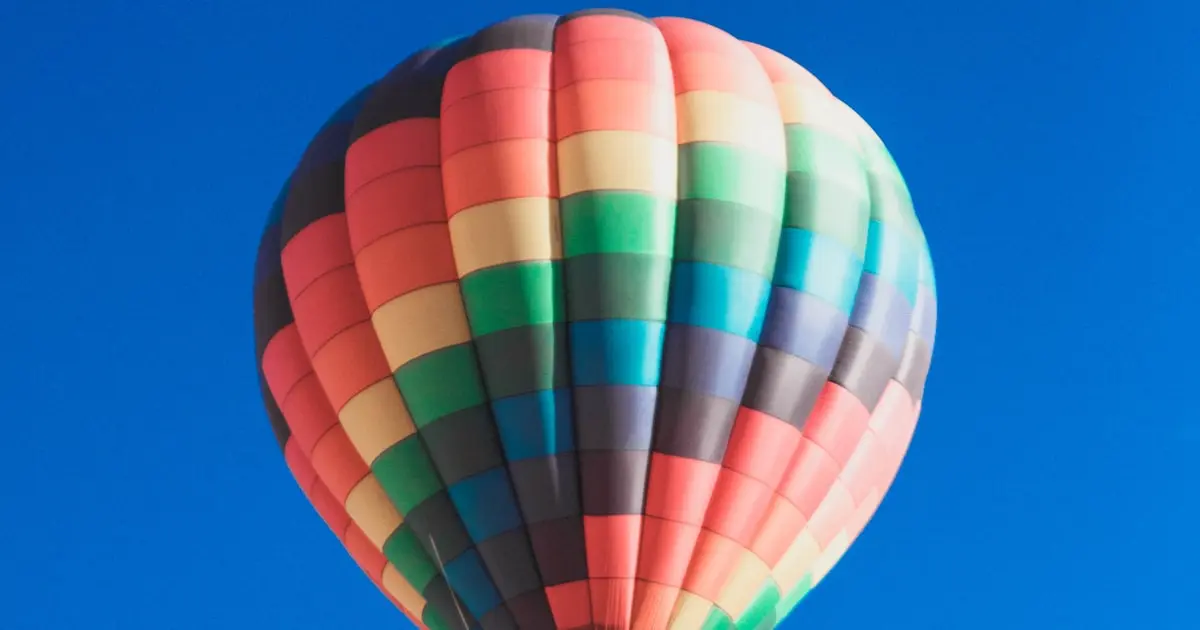
Taller Than a Seven-Storey Building
A standard passenger hot air balloon stands approximately 20 to 25 metres tall when fully inflated — roughly the height of a seven-storey building. The envelope alone, from the mouth at the bottom to the crown at the top, measures 18 to 22 metres. Add the basket suspended beneath and the total height from ground to crown reaches 23 to 28 metres.
Those numbers do not quite prepare you for the reality. Standing next to a fully inflated balloon in the pre-dawn darkness, looking up at a structure taller than most buildings in your neighbourhood, is one of the most striking moments of the experience. For tips on making the most of that first encounter, see our guide for first-time riders.
Envelope Size: Volume, Diameter and Weight
Volume
The size of a balloon's envelope is measured in volume — how many cubic metres of air it can contain. This is the single most important measurement, because volume determines how much lift the balloon generates.
Envelope volumes range from around 1,400 cubic metres (50,000 cubic feet) for a small two-person sport balloon to over 8,500 cubic metres (300,000 cubic feet) for the largest commercial passenger balloons. The most common sizes for tourism flights fall between 2,200 and 4,200 cubic metres.
To put those numbers in perspective:
- 1,400 m³ (small sport balloon): equivalent to the volume of a modest two-bedroom flat
- 2,800 m³ (standard passenger balloon): roughly the volume of an Olympic swimming pool
- 4,200 m³ (large commercial balloon): enough to fill a medium-sized church
- 8,500 m³ (extra-large commercial balloon): approximately the volume of three Olympic swimming pools
The relationship between volume and lift is direct. Every cubic metre of heated air displaces a cubic metre of cooler, denser outside air. The difference in weight — roughly 0.25 kilograms per cubic metre at typical operating temperatures — is the source of lift. A 2,800 m³ envelope generates approximately 700 kilograms of gross lift. Subtract the weight of the balloon system and you have the payload capacity for passengers, crew and fuel. For the full physics, see why hot air balloons rise.
Diameter
The maximum width of a typical passenger balloon envelope is 15 to 22 metres — roughly the width of a tennis court for a standard balloon, or the width of a basketball court for the largest commercial sizes.
Envelope Weight
The envelope alone weighs between 100 and 180 kilograms, depending on size and material. A standard 2,800 m³ passenger envelope weighs approximately 120 to 150 kilograms. Spread across 2,000 to 3,000 square metres of fabric, the material is remarkably light — just 40 to 60 grams per square metre.
The fabric is ripstop nylon or polyester, coated with silicone or polyurethane to reduce porosity and resist UV degradation. Despite its light weight, it is engineered to withstand 400 to 800 flight hours of inflation, flight and deflation.
Basket Size: Dimensions and Passenger Capacity
How Big Is a Hot Air Balloon Basket?
The basket — also called the gondola — comes in a range of sizes:
- 2-person basket: approximately 1.0 m x 1.0 m (compact, for sport or romantic flights)
- 4-person basket: approximately 1.2 m x 1.2 m
- 8-person basket: approximately 1.3 m x 1.5 m, often with a central partition
- 12-person basket: approximately 1.3 m x 1.8 m, divided into compartments
- 16-person basket: approximately 1.5 m x 2.0 m, multiple compartments
- 20 to 24-person basket: approximately 1.6 m x 2.2 m or larger, with a central pilot compartment and four passenger sections
Baskets are typically 1.0 to 1.3 metres tall — roughly waist height on an average adult. This height provides a secure feeling without blocking the view, and is high enough that no one is at risk of falling out. Rope handles line the interior walls at chest height for secure handholds.
How Many People Fit in a Hot Air Balloon?
The number of passengers depends on envelope volume, basket size and total payload limit:
| Envelope Volume | Basket Type | Typical Capacity |
|---|---|---|
| 1,400–1,800 m³ | Small sport | 2–3 passengers + pilot |
| 2,200–2,800 m³ | Standard | 6–12 passengers + pilot |
| 3,000–4,200 m³ | Large commercial | 12–20 passengers + pilot |
| 4,500–6,000 m³ | Extra-large commercial | 16–24 passengers + pilot |
In Marrakech, the balloons used for our Classic Flight typically carry 16 to 20 passengers in a compartmentalised basket. Each passenger has enough room to stand comfortably and move a camera to either side of the basket. The divided compartments mean you are standing with three to five other people in your section, not 20.
For groups wanting more space, our Private Flight reserves the entire balloon for your party. A private group of four in a 20-person basket has an enormous amount of room.
Total System Weight
The complete weight of a hot air balloon — everything except passengers and fuel — typically falls between 250 and 400 kilograms:
| Component | Approximate Weight |
|---|---|
| Envelope | 120–150 kg |
| Basket (with frame and runners) | 70–100 kg |
| Burner system (twin burner) | 30–40 kg |
| Instruments and radio | 5–10 kg |
| Fuel cylinders (empty) | 30–40 kg |
| Total (excluding fuel and passengers) | 255–340 kg |
Add 80 to 120 kilograms of liquid propane and the system weight before passengers board is approximately 350 to 460 kilograms. The remaining lifting capacity is available for passengers and crew.
Weight Limits and Passenger Restrictions
Most balloon operators do not impose a specific per-passenger weight limit. Instead, the pilot manages the total payload. The balloon has a maximum certified all-up weight, and the pilot ensures this limit is not exceeded.
In practice, the pilot adjusts the number of passengers based on conditions. On a cool morning with excellent lift, the balloon carries its full rated capacity. On a warmer morning with reduced buoyancy, the pilot may fly with one or two fewer passengers to maintain safe performance margins. If you have concerns, mention them when booking — reputable operators handle these conversations with discretion. Our safety guide covers operational standards in detail.
Size Comparisons
Numbers on a page can be abstract. Here are comparisons that make the scale tangible:
- Height (25 m): taller than a seven-storey residential building, twice the height of a mature oak tree
- Envelope diameter (18 m): wider than a tennis court, roughly the wingspan of a Boeing 737
- Envelope volume (2,800 m³): approximately equal to one Olympic swimming pool
- Envelope fabric area (2,500 m²): roughly half the area of a football pitch
- System weight (300 kg): about the same as a large motorcycle
When you watch a balloon inflate from flat fabric to a towering dome in the darkness, these comparisons become visceral. For tips on capturing that moment, see our photography guide.
How Big Are the Balloons in Marrakech?
The balloons used in Marrakech are standard large-commercial size: envelopes of approximately 3,000 to 4,200 cubic metres, baskets carrying 16 to 20 passengers in divided compartments, and twin-burner systems producing 3 to 5 million BTU. Standing in the basket, you are surrounded by wicker walls at waist height with unobstructed views in every direction. Above you, the enormous envelope blocks a circle of sky, with the burner frame directly overhead.
The scale becomes most apparent during inflation. Arriving at the launch field in the dark, you see crew members laying out what appears to be an impossibly large sheet of fabric. Within 20 minutes, it has become a structure taller than the buildings you passed on the drive out of Marrakech. That transformation is part of the magic, and understanding how hot air balloons work makes it even more impressive.
See the Scale for Yourself
Reading about how big a hot air balloon is cannot substitute for standing next to one. The experience of looking up at a fully inflated envelope against a sunrise sky, then stepping into the basket and feeling it lift gently off the ground, is something numbers alone cannot convey.
Our Classic Flight offers the full experience — inflation, flight, landing and a traditional Moroccan breakfast — starting at 1,700 Dhs per person. For groups wanting the space and privacy of the entire balloon, the Private Flight is available from 5,000 Dhs. Both options include hotel transfers and operate daily at sunrise, year-round.