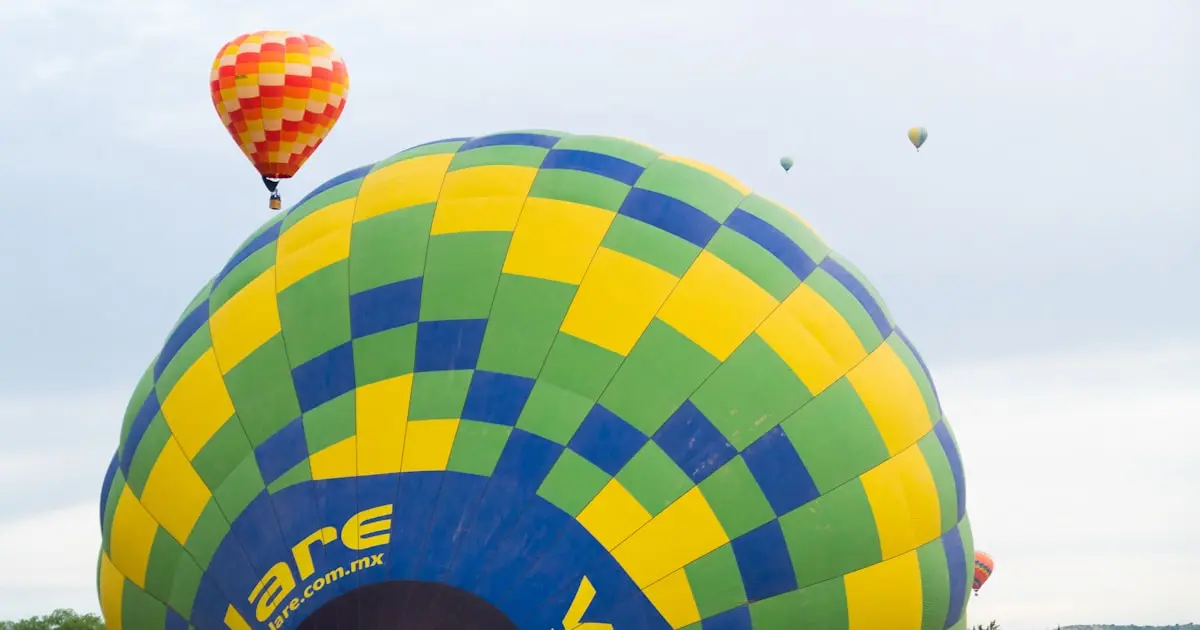
There is a wonderful paradox at the heart of hot air ballooning: you are moving through the sky at considerable speed, yet you feel absolutely nothing. No wind in your hair, no rushing air against your face, no sense of motion at all. You could light a candle in the basket and the flame would not flicker. This is because a hot air balloon does not fly through the wind — it flies with it, carried along as part of the air mass itself.
So how fast do hot air balloons actually go? And how far do they travel during a typical flight? The answers reveal something fascinating about the nature of balloon flight and why it feels so utterly different from every other way of getting airborne.
Typical Hot Air Balloon Speed
A commercial hot air balloon flight typically travels at 8 to 16 kilometres per hour (5 to 10 miles per hour). This is roughly the speed of a brisk walk to a gentle jog — not especially fast in absolute terms, but fast enough to cover a meaningful distance during a one-hour flight.
The key thing to understand is that balloons have no engine, no propeller, and no way of generating their own forward thrust. They move at exactly the speed of the wind at their current altitude. If the wind is blowing at 12 km/h, the balloon travels at 12 km/h. If the wind drops to 5 km/h, so does the balloon. If the wind stops entirely — which does happen on very calm mornings — the balloon simply hovers in place.
This complete dependence on the wind is what gives ballooning its unique character. As we explain in our guide to how hot air balloons are steered, pilots navigate not by pointing the balloon in a particular direction but by ascending or descending to find wind layers moving in the direction they wish to travel. It is a form of flight that requires patience, observation, and a deep understanding of atmospheric behaviour.
Why You Cannot Feel the Speed
This is the question that surprises most first-time flyers: if you are moving at 12 km/h, why does it feel like you are standing still?
The explanation is beautifully simple. Wind is moving air. When you stand on the ground and feel wind on your face, you are stationary while the air moves past you. In a balloon, you are inside the moving air mass, travelling with it at exactly the same speed. There is no relative motion between you and the air around you, so there is nothing to feel.
It is exactly like standing in the cabin of a smoothly moving train. You know you are moving because the landscape slides past, but your body feels nothing. In a balloon, the effect is even more pronounced because there is no vibration, no engine noise, and no track clatter — just silence and the slow drift of the world below.
This is one of the reasons ballooning is so accessible to people of all ages and fitness levels. There is no physical stress, no G-force, no buffeting. If you have ever wondered whether a balloon ride would be comfortable, our first-time flyer guide covers what to expect in detail.
How Far Does a Hot Air Balloon Travel?
During a standard one-hour commercial flight, a hot air balloon will cover somewhere between 8 and 16 kilometres from the launch site. The exact distance depends entirely on the wind speed that morning.
On a very calm day with light winds of 5-8 km/h, you might travel only 5 to 8 kilometres. On a morning with moderate winds of 15 km/h, you could cover 15 kilometres or more. This is why balloons almost never return to their launch site — they travel in whatever direction the wind carries them, and a chase crew follows on the ground to meet them at the landing point.
The distance covered is part of what makes each balloon flight unique. You never follow the same route twice. The landscape that passes beneath you depends on the particular wind conditions of that specific morning, which means every flight offers genuinely different views.
Wind Speed and Flight Safety
While light to moderate winds make for wonderful flying, stronger winds create conditions that are unsuitable for ballooning. Most commercial operators will cancel flights if surface winds exceed 16 to 20 km/h (10 to 12 mph) at launch time, or if upper-level winds are forecast to be significantly stronger.
There are several reasons for this:
Launch and Landing Difficulty
The most vulnerable moments of any balloon flight are the launch and landing. A fully inflated balloon presents an enormous surface area to the wind — typically 2,000 to 3,000 square metres of fabric. In winds above 15 km/h, controlling the envelope during inflation becomes extremely difficult, and landings become rougher and harder to manage safely.
Passenger Comfort
Even though you cannot feel wind speed during flight, higher wind speeds mean faster ground speed, which makes the landing more energetic. A balloon landing at 8 km/h is a gentle affair. A landing at 20 km/h involves the basket bumping and potentially tipping — safe but not especially comfortable.
Predictability
In lighter winds, the atmosphere tends to be more stable and predictable. The pilot can read the wind patterns more accurately and make better decisions about altitude and direction. In stronger winds, conditions become more variable and turbulent, which reduces the pilot's control.
This is why balloon flights are scheduled for early morning, typically launching within an hour of sunrise. The morning hours offer the calmest, most stable conditions of the day. As the sun heats the ground through the morning, thermal activity increases, winds pick up, and conditions become progressively less suitable for ballooning.
If your flight is cancelled due to wind, our guide on what happens when a Marrakech balloon flight is cancelled explains the rebooking process.
Speed Records and Extreme Flights
While commercial balloon flights are leisurely affairs, the history of ballooning includes some remarkable speed achievements.
Around the World
Steve Fossett completed the first solo non-stop circumnavigation of the globe by balloon in 2002, covering 33,195 kilometres in just under 15 days. His average speed was approximately 92 km/h, though he reached much higher speeds at times by flying at high altitudes where jet stream winds can exceed 200 km/h.
Fossett's balloon, the Bud Light Spirit of Freedom, was a Rozier balloon — a hybrid design using both hot air and helium — and he flew at altitudes of up to 10,500 metres to catch the powerful high-altitude winds that circle the globe.
The Jet Stream
The jet stream is a band of very fast-moving air at altitudes of 7,000 to 12,000 metres, with speeds that can reach 400 km/h (250 mph). While no commercial balloon flight goes anywhere near these altitudes, the jet stream has been used by long-distance balloon expeditions to achieve extraordinary speeds and distances.
The existence of these high-altitude wind rivers illustrates the fundamental principle of balloon flight taken to its extreme: the balloon goes wherever the wind goes, and the wind at different altitudes can be moving in entirely different directions and at vastly different speeds.
Wind Conditions in Marrakech
The Marrakech region benefits from particularly favourable wind conditions for ballooning, which is one of the reasons it has become one of the world's top balloon destinations.
Morning Winds
During the early morning hours when flights operate, winds over the Palmerie and surrounding areas are typically 5 to 15 km/h. These gentle breezes provide just enough movement to carry the balloon across the landscape at a pleasant pace, covering 8 to 12 kilometres during a one-hour flight.
The wind direction in the Marrakech region tends to flow from the Atlas Mountains towards the plains in the early morning, creating a relatively predictable pattern that experienced local pilots know intimately. This consistency is a significant safety advantage — pilots can plan their likely flight path with reasonable accuracy before they even leave the ground.
Seasonal Variations
Wind patterns do vary with the seasons. Winter mornings (November to February) tend to be the calmest, with very light winds and crisp, clear visibility. Spring and autumn offer moderate winds and comfortable temperatures. Summer mornings can be slightly windier, though the very early launch time (around 5:30 AM) means flights usually take place before the day's thermal winds develop.
Our detailed seasonal guide breaks down what to expect throughout the year.
The Pilot's Wind Reading
Before every flight, the pilot conducts a wind assessment. This often involves releasing a small helium-filled pilot balloon (called a pi-ball) and watching its trajectory — how fast it rises, how quickly it drifts, and whether it changes direction at different altitudes. This simple technique has been used by balloonists for over two centuries and remains one of the most reliable ways to read the wind before committing to a flight.
The pilot also reviews meteorological forecasts, satellite data, and reports from other pilots who may have flown earlier that morning. All of this information feeds into the decision about whether to fly and what general route to expect. For more on this process, see our guide on balloon safety in Marrakech.
Speed Compared to Other Aircraft
To put balloon speeds in context:
- Hot air balloon: 8-16 km/h
- Paraglider: 20-60 km/h
- Helicopter: 200-260 km/h
- Light aircraft: 180-280 km/h
- Commercial jet: 800-950 km/h
A balloon is by far the slowest way to fly, and that is precisely the point. Speed is not the purpose of a balloon ride — the purpose is the experience of floating, of silence, of seeing the world from a perspective that no other form of transport can provide. There is a reason the science behind how balloons work has captivated people for nearly 250 years.
What Speed Feels Like in the Basket
First-time passengers often comment that the flight felt "motionless" or "like floating in place." This is not an illusion — or rather, it is an accurate perception of your relationship to the air around you. You genuinely are stationary relative to the air mass.
The only time you become aware of movement is when you look down. The landscape drifts slowly beneath you — a goat herd crossing a field, the shadow of the balloon gliding over palm groves, a road unwinding through the Berber countryside. It is movement without motion, travel without effort, and it creates a sense of peace that is genuinely difficult to describe until you have experienced it.
Ready to Float Over Marrakech?
A hot air balloon flight over the Palmerie carries you gently at 8-15 km/h across one of Morocco's most stunning landscapes — and you will not feel a breath of wind the entire time. It is the slowest, quietest, and most serene way to travel, and it is available every morning at sunrise.
Check our schedule and booking information to reserve your flight, and take a look at our photography tips so you can capture every moment of the journey. We look forward to welcoming you aboard.