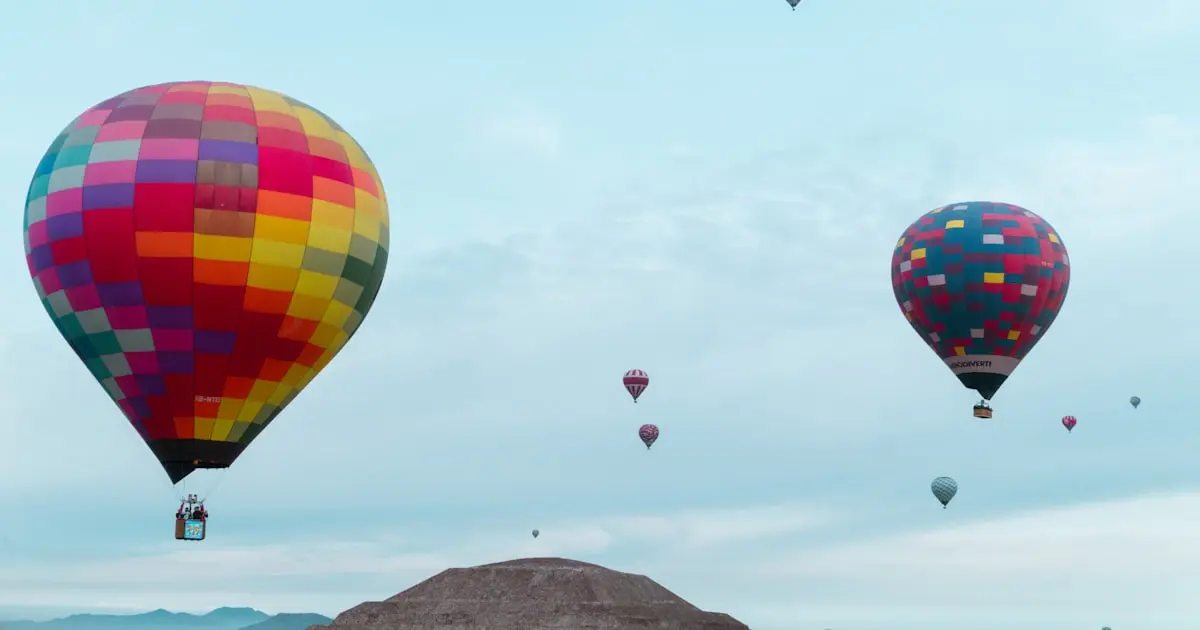
When you step into the basket of a hot air balloon for the first time, the question that usually crosses your mind — right after "is this safe?" — is "how high are we going to go?" It is a perfectly natural thing to wonder. The answer, as it turns out, depends entirely on what kind of flight you are talking about. A commercial sightseeing ride and a world-record attempt are separated by roughly twenty thousand metres of altitude, a pressurised cabin, and an extraordinary amount of nerve.
Let us explore the full range of how high hot air balloons can fly, what limits their altitude, and what you can expect on a typical flight over the skies of Marrakech.
The World Record: 21,290 Metres
The highest a hot air balloon has ever flown is 21,290 metres (69,850 feet) — well into the stratosphere. Indian aviator Vijaypat Singhania set this record on 26 November 2005, launching from a site near Mumbai and ascending to an altitude higher than most commercial aircraft fly.
Singhania's balloon was no ordinary affair. The envelope measured over 49 metres tall, roughly the height of a sixteen-storey building. The basket was replaced by a pressurised capsule equipped with supplemental oxygen and heating, because at that altitude the outside temperature plummets to around minus 60 degrees Celsius and the air pressure is a fraction of what it is at sea level.
This record still stands more than two decades later, which gives you some idea of how extreme the undertaking was. It is the ballooning equivalent of climbing Everest — technically possible, but not something you would do on a weekend outing.
Typical Commercial Flight Altitude
Now for the number that actually matters if you are booking a balloon ride: most commercial hot air balloon flights operate between 300 and 600 metres above ground level (AGL), which works out to roughly 1,000 to 2,000 feet.
This is the sweet spot for sightseeing. At 300 metres you are high enough to take in sweeping panoramic views, spot landmarks, and appreciate the landscape from a perspective you will never get from a car or even a hilltop. Yet you are low enough that the ground still feels connected to you — you can see individual trees, wave at people below, and watch animals going about their day.
During a typical one-hour flight, the pilot will vary the altitude considerably. You might skim just 30 metres above treetops at one point, then climb to 500 metres for a broader view ten minutes later. This variation is part of what makes a balloon ride so different from any other form of flight — the pilot has an artist's freedom to choose the altitude that gives passengers the best experience at any given moment.
What Limits How High a Hot Air Balloon Can Fly?
Several factors work together to impose a practical ceiling on balloon altitude. Understanding them helps explain why commercial flights stay relatively low — and why record-breaking flights require such extraordinary preparation.
Oxygen Availability
Above approximately 3,000 metres (10,000 feet), the air becomes thin enough that most people will begin to feel the effects of reduced oxygen. Mild hypoxia sets in: lightheadedness, impaired judgement, shortness of breath. Above 4,500 metres these effects become serious, and above 8,000 metres supplemental oxygen is not just advisable but essential for survival.
Commercial balloon flights carry no oxygen equipment because they simply do not need it at 300-600 metres. The air at that altitude is virtually identical to what you breathe on the ground.
Temperature Drop
Air temperature decreases by roughly 2 degrees Celsius for every 300 metres of altitude gained. This is known as the environmental lapse rate, and it has two consequences for ballooning.
First, passengers get cold. At 600 metres above the Marrakech desert, the temperature might be 4-5 degrees cooler than on the ground — noticeable but manageable, especially if you have followed our advice on what to wear. At 6,000 metres it would be roughly 40 degrees colder, which is simply not practical for an open basket.
Second, the colder surrounding air actually helps the balloon in one sense — the temperature differential between the heated air inside the envelope and the ambient air outside increases, which generates more lift. But this advantage is eventually overwhelmed by the decreasing air density.
Air Density and the Envelope
Hot air balloons rise because the heated air inside the envelope is less dense than the cooler air outside. As the balloon climbs higher, the surrounding air becomes less dense. To maintain the same density differential, the pilot must heat the air inside the envelope to increasingly higher temperatures.
Eventually, you reach a point where the fabric of the envelope cannot safely withstand the required temperatures. Modern balloon envelopes are made from ripstop nylon or polyester, typically rated to withstand sustained temperatures of around 120-130 degrees Celsius. Push beyond that and the fabric begins to degrade, which is obviously not something any sensible pilot would do.
Fuel Limitations
Higher altitudes demand more fuel. The burners must work harder and more frequently to maintain the greater temperature differential needed for lift in thinner air. A standard commercial balloon carries enough propane for about 90 minutes of flight at normal altitudes. Attempting to sustain significantly higher altitudes would burn through that fuel far more quickly, reducing flight time and safety margins.
If you are curious about how the burner system works in detail, we have a full guide that explains the mechanics.
Aviation Regulations and Airspace
Altitude is not just a matter of physics — it is also a matter of law. Aviation authorities around the world impose airspace rules that balloon pilots must follow.
International Airspace Classifications
In most countries, the airspace below approximately 1,200 feet (370 metres) AGL in non-controlled areas is classified as Class G — uncontrolled airspace. Balloon pilots can operate here with relatively few restrictions, provided they maintain visual flight rules (VFR) and remain clear of controlled zones around airports.
Above 1,200 feet AGL, the airspace typically transitions to Class E, which is controlled. Balloon pilots can still fly here, but they must comply with additional visibility requirements and may need to communicate with air traffic control in certain areas.
In Morocco, balloon operations follow regulations set by the Moroccan Civil Aviation Authority. Operators must hold appropriate licences and approvals, and flights are conducted in coordination with local aviation authorities to ensure separation from other air traffic.
Practical Implications
For commercial balloon rides, these regulations are rarely a constraint because the preferred sightseeing altitude falls comfortably within Class G airspace. Pilots stay below 600 metres not because the law forces them to, but because that is where the best views and safest flying conditions exist.
How High Do Balloons Fly in Marrakech?
On a typical hot air balloon flight in Marrakech, you can expect to reach altitudes of 200 to 400 metres above the Palmerie and surrounding landscape.
The Marrakech region is particularly well-suited to ballooning at these altitudes. The terrain is relatively flat, which means 200-400 metres AGL gives you commanding views across the palm groves, scattered Berber villages, olive groves, and — on clear mornings — the snow-capped Atlas Mountains stretching along the southern horizon.
Pilots will typically begin with a gentle ascent after launch, climbing steadily while the passengers settle in and begin to appreciate the expanding view. The highest point of the flight often comes in the middle portion, when the pilot seeks out the best wind layer for the desired direction of travel. As the flight draws towards its conclusion, the pilot will gradually descend, sometimes bringing the basket remarkably close to the ground before the final approach to the landing site.
The early morning conditions that Marrakech is known for — stable air, light winds, excellent visibility — make altitude changes smooth and gentle. There are no sudden drops or lurches. The ascent and descent feel so gradual that many passengers report not even noticing they are climbing until they look down.
Does Altitude Affect the Experience?
Absolutely, but perhaps not in the way you might expect. Higher is not necessarily better when it comes to enjoyment.
At 100-200 metres, the experience is intimate. You can see details on the ground — the pattern of crops in a field, a shepherd walking with his flock, the shadow of your own balloon gliding across the landscape. Sounds from below drift up clearly: a rooster crowing, a dog barking, the faint rumble of a tractor.
At 300-500 metres, the perspective shifts to something more panoramic. Individual details blur, but the grand sweep of the landscape reveals itself. You can see the curvature of river beds, the geometric patchwork of farmland, and the way villages cluster around water sources.
The best flights offer both perspectives, and experienced pilots know this. They will vary altitude throughout the flight to give you the full range of sensations.
Is the Height Frightening?
Many people who are nervous about heights find that a hot air balloon is surprisingly comfortable. Because the basket has solid sides, there is no sense of exposure. Because the balloon moves with the wind, there is no turbulence or swaying. And because the ascent is so gradual, there is no stomach-dropping moment of sudden altitude gain.
If height is a concern for you, our guide on overcoming the fear of heights on a balloon ride covers this in much more detail and may put your mind at ease.
Comparing Balloon Altitude to Other Aircraft
To put balloon altitudes in perspective:
- Drone: 0-120 metres (legal limit in most countries)
- Hot air balloon (commercial): 200-600 metres
- Helicopter sightseeing tour: 300-900 metres
- Skydiving jump altitude: 3,000-4,500 metres
- Light aircraft: 1,500-3,000 metres
- Commercial airliner: 9,000-12,000 metres
- Balloon world record: 21,290 metres
What sets ballooning apart from every other entry on this list is the quality of the experience at its operating altitude. You are high enough to see the world from a genuinely new perspective, yet low enough to remain connected to it. There is no engine noise, no vibration, no sealed cabin window between you and the landscape. It is flight in its purest, most elemental form.
Ready to See the World from Above?
A hot air balloon ride over Marrakech offers views from 200-400 metres above the Palmerie, the Atlas Mountains, and the scattered Berber villages below. It is high enough to take your breath away — and gentle enough that you will wish you could stay up there all morning.
Flights depart at sunrise every day, weather permitting. Read our first-time flyer tips to prepare for your flight, or check our price guide to find the right experience for your budget. We would love to take you up.