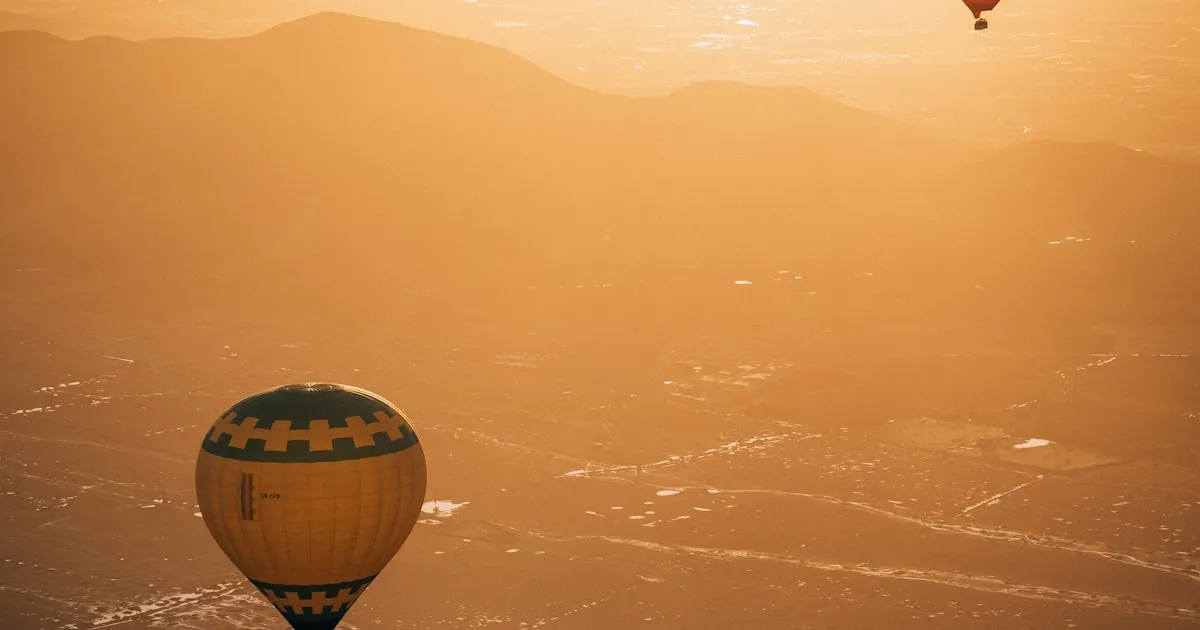
The Oldest Form of Human Flight Still Works Beautifully
The hot air balloon is the simplest flying machine ever invented. No engine, no wings, no runway. Just heated air trapped inside a fabric envelope, obeying the same physics that the Montgolfier brothers demonstrated in 1783. And yet, for all its simplicity, how a hot air balloon actually works is something most passengers never think about — until they are standing in the pre-dawn darkness watching one inflate for the first time.
Understanding the science does not diminish the experience. It deepens it. When you know what the pilot is doing and why, every burst of the burner, every subtle altitude change and every shift in direction becomes more meaningful. Here is the full picture of how hot air balloons work, from the physics of lift to the reason Marrakech is one of the best places on earth to fly one.
The Basic Principle: Hot Air Rises
Every hot air balloon flight relies on a single physical law: hot air is less dense than cold air. This is Archimedes' principle of buoyancy, applied not to water but to the atmosphere. The same force that makes a beach ball float in a swimming pool makes a balloon float in the sky.
Air is a gas with weight. At sea level, a cubic metre of air at 20 degrees Celsius weighs roughly 1.2 kilograms. Heat that same air to 100 degrees Celsius and its density drops to approximately 0.95 kilograms per cubic metre. The difference — about 0.25 kilograms per cubic metre — is the source of lift.
A standard passenger balloon has an envelope volume of around 2,800 cubic metres (100,000 cubic feet). Multiply that volume by the density difference, and you get a lifting force of roughly 700 kilograms. Subtract the weight of the envelope, basket, burner system, fuel and passengers, and you have your net lift — the force that takes you skyward.
That is the entire mechanism. There is no combustion engine, no thrust, no aerodynamic lift surface. A hot air balloon rises because the air inside it weighs less than the air outside it. It descends when the air inside cools or when the pilot deliberately releases hot air. Everything else — the burners, the valve, the instruments — exists to control this single variable: the temperature of the air inside the envelope.
How the Heating System Works
The Burners
The burner is the heart of the balloon. Mounted directly above the basket on a metal frame, it fires liquid propane upward into the mouth of the envelope. When the pilot pulls the blast valve, propane flows from the fuel tanks through a vaporiser coil (heated by the flame itself), turns to gas, and ignites in a controlled jet that reaches temperatures above 1,000 degrees Celsius at the nozzle.
The numbers are remarkable. A standard twin-burner system produces 3 to 5 million BTU of heat output — equivalent to roughly 1,000 household kitchen stoves running simultaneously. That enormous capacity is necessary because the envelope is not insulated. Hot air is constantly escaping through the fabric and the open mouth at the bottom. The burner does not heat the air once; it continually tops up the heat lost through radiation and convection.
Most commercial balloons carry twin or triple burners for redundancy. If one burner fails, the remaining unit provides enough heat to control the balloon and land safely. This redundancy is a regulatory requirement, not an optional feature.
Fuel Supply
The basket carries two to four aluminium propane cylinders, each holding approximately 40 litres of liquid propane. A typical one-hour flight consumes around 150 litres of propane in total. The fuel is carried in liquid form because liquid propane stores far more energy per litre than gaseous propane. It vaporises as it passes through the burner's heating coil before igniting.
Temperature Control
The pilot monitors the air temperature inside the envelope using a thermometer mounted at the crown — the highest point of the envelope. During flight, the air inside typically reaches 100 to 120 degrees Celsius (212 to 248 degrees Fahrenheit). Go too cold and the balloon descends. Go too hot and you stress the fabric, which has a maximum safe operating temperature specified by the manufacturer, usually around 120 to 130 degrees Celsius.
The relationship between burner input and altitude response is not instant. There is a delay of several seconds between firing the burner and seeing the balloon respond, because it takes time for the heated air to distribute through the enormous volume of the envelope. This lag is one of the things that makes piloting a balloon a genuine skill — the pilot is always thinking several seconds ahead.
The Anatomy of a Hot Air Balloon
The Envelope
The envelope is the large fabric canopy — the most visually striking part of the balloon. It is manufactured from ripstop nylon or polyester, sewn into vertical panels called gores, which are themselves divided into horizontal sections. A typical passenger envelope has 24 gores and weighs between 100 and 150 kilograms.
The fabric is coated with silicone or polyurethane to reduce porosity (the rate at which air seeps through the weave) and to resist UV degradation. Despite this treatment, envelopes have a finite lifespan — typically 400 to 800 flight hours or around 10 years — after which the fabric's strength and porosity fall below acceptable limits. For more on inspection standards, see our safety guide.
The Parachute Valve
At the very top of the envelope sits a circular panel of fabric called the parachute valve (or deflation panel). It is held in place by a Velcro seal and controlled by a rope that runs down through the centre of the envelope to the basket.
This valve is the pilot's primary descent control. Pulling the rope slightly opens the valve, allowing hot air to escape from the crown. With less hot air, buoyancy decreases, and the balloon descends. Release the rope and the valve reseals. For landing, the pilot can pull the rope fully to open the valve wide, rapidly deflating the envelope.
The term "parachute" refers to the shape of the panel, not its function — it looks like a small parachute sitting inside the top of the envelope. It is a simple, elegant and highly reliable mechanism.
The Basket (Gondola)
The basket is made of woven wicker — and this is not tradition for tradition's sake. Wicker has properties that make it genuinely superior to rigid alternatives for balloon baskets:
- Impact absorption: Wicker flexes on landing, distributing and absorbing the energy of contact with the ground. A rigid aluminium or fibreglass basket would transmit every jolt directly to the passengers.
- Strength-to-weight ratio: A wicker basket strong enough to carry 12 passengers weighs significantly less than a metal equivalent.
- Durability: Wicker baskets last for years of daily use with proper maintenance, and individual damaged sections can be repaired without replacing the entire structure.
The basket sits on a lightweight metal frame with runners along the base to facilitate ground handling. Inside, it is divided into compartments — typically a central section for the pilot and fuel tanks, with passenger compartments around the outside. Rope handles line the interior walls; these are the handholds passengers grip during landing.
Instruments
The instrument panel is modest compared to a fixed-wing aircraft, but every gauge serves a critical purpose:
- Altimeter: measures altitude above sea level (or above ground level, depending on calibration)
- Variometer: measures the rate of climb or descent in metres per second — the single most useful instrument for fine-tuning altitude
- Envelope temperature gauge: monitors the air temperature at the crown of the envelope
- Compass: basic directional orientation
- GPS: provides precise position data and ground speed
- Radio: for communication with the ground crew and air traffic control
How Pilots Steer a Balloon
This is the question that surprises most first-time passengers: you cannot steer a hot air balloon. There is no rudder, no ailerons, no thrust vectoring. A balloon goes where the wind takes it. Period.
So how does the pilot control where you fly? By exploiting the fact that wind direction changes with altitude. At 200 metres, the wind might blow from the northwest. At 500 metres, it might come from the west. At 800 metres, it could swing to the southwest. The pilot navigates by moving the balloon vertically between these different wind layers, effectively choosing which current to ride.
This is the fundamental skill of balloon piloting: reading the wind. Before every flight, the pilot studies weather data that maps wind speed and direction at multiple altitudes — a vertical profile of the atmosphere called a wind sounding. During the flight, the pilot constantly observes the balloon's track over the ground using GPS, the movement of other balloons at different heights, and visual cues like dust, smoke and the drift of the envelope itself.
The result is not precise navigation in the aircraft sense. A pilot cannot fly to a specific street address. But an experienced pilot — one who has flown the same terrain hundreds or thousands of times — can select a general direction of travel, avoid obstacles, and choose a landing area with surprising accuracy.
Ground crew plays a critical role here. The chase vehicle follows the balloon on the roads below, tracking its position by radio and GPS. As the flight progresses, pilot and crew coordinate on the landing site — the pilot describes what open areas are within reach, the crew confirms road access, and together they agree on a target zone.
The Inflation Process
Watching a balloon inflate is one of the most memorable parts of the morning, particularly for first-time flyers. The process takes 15 to 20 minutes and follows a precise sequence.
Step 1: Laying Out the Envelope
The crew unloads the envelope from the trailer and spreads it flat on the ground downwind of the basket. The mouth of the envelope faces the basket, and the crown stretches out 25 to 30 metres across the field. At this stage it looks like an impossibly large sheet of fabric — because it is.
Step 2: Cold Inflation
A powerful petrol-driven fan is positioned at the mouth of the envelope and switched on. It forces ambient air into the envelope, filling it like an enormous wind sock lying on its side. This cold inflation takes 5 to 10 minutes and requires crew members to hold the mouth open and to restrain the crown.
Step 3: Hot Inflation
With the envelope partially inflated with cold air, the pilot lights the burner and directs the flame into the mouth. The air inside begins to warm. Over the next few minutes, the envelope slowly lifts off the ground, rising from horizontal to vertical in a smooth, stately arc. This is the moment that draws every camera — a vast, colourful dome rising against the pre-dawn sky.
Step 4: Boarding
With the envelope fully upright and the burner maintaining lift, the crew holds the basket steady while passengers climb in. The pilot gives a brief safety briefing, confirms everyone is positioned correctly, and the flight begins.
The Flight Itself
A typical balloon flight over Marrakech lasts 45 to 60 minutes, covering a distance of roughly 5 to 15 kilometres depending on wind speed. The experience is defined by its quietness — between burner blasts, there is near-total silence. No engine noise, no wind rush (because you are moving with the wind), just the occasional distant sound drifting up from the ground below.
Altitude
Flights typically operate between 500 and 1,000 metres above ground level. The pilot varies altitude throughout the flight — climbing high for panoramic views of the Atlas Mountains, descending low to skim over palm groves and Berber villages. That range of perspectives is what makes the experience so varied. For details on the landscapes you will see, read our guide to what you see from a hot air balloon over Marrakech.
Speed
Ground speed depends entirely on the wind and typically ranges from 8 to 20 kilometres per hour — walking pace to cycling pace. This gentle movement is part of what makes ballooning feel so different from any other form of flight. There is no sensation of speed, no turbulence, no vibration. You float.
Fuel Consumption
A one-hour flight burns approximately 150 litres of liquid propane across the balloon's fuel tanks. The pilot monitors fuel levels throughout the flight and plans the landing with a mandatory fuel reserve — there must always be enough propane remaining for at least 20 minutes of additional flight time.
The Landing
Landing is the phase that generates the most questions from passengers, and understandably so. The truth is that landings vary — some are feather-light, others are firm. The pilot's skill, the wind conditions and the terrain all play a role.
How the Pilot Selects a Landing Site
As the flight progresses and fuel decreases, the pilot begins identifying potential landing areas. The criteria are straightforward: flat, open terrain with no power lines, no livestock, and road access for the chase vehicle. In the Marrakech region, the flat agricultural plains provide abundant options.
The pilot communicates with the ground crew via radio, describing the intended approach path and target area. The crew positions the vehicle accordingly and prepares for the post-landing recovery.
The Approach and Touchdown
The pilot reduces altitude gradually, opening the parachute valve to release hot air and using short burner blasts to control the rate of descent. In calm conditions, the basket touches down gently and stays upright. In windier conditions, the basket may drag along the ground for a short distance before stopping — which is precisely why it is built from flexible wicker rather than rigid metal.
Passengers are briefed before landing to adopt the landing position: face the direction of travel, bend your knees, hold the rope handles firmly, and keep your arms inside the basket. This position lets your legs absorb the impact naturally, like stepping off a low kerb.
Once the basket is stationary, the pilot fully opens the parachute valve, deflating the envelope. The crew arrives, secures the basket, and begins packing the balloon back onto the trailer.
Why Marrakech Is Ideal for Ballooning
Not every destination suits hot air ballooning. The activity requires specific geographic and climatic conditions that many popular tourist regions simply do not have. Marrakech has nearly all of them.
Climate
Marrakech receives over 300 sunny days per year, making weather cancellations rare — fewer than 5% of scheduled flights are grounded across the year. The dry, stable atmosphere produces clear morning skies with excellent visibility, often extending 50 kilometres or more toward the Atlas Mountains.
Morning Conditions
The cool mornings are a critical advantage. Hot air balloon lift depends on the temperature differential between the air inside the envelope and the air outside. The cooler the ambient air, the greater the differential and the more efficient the lift. Marrakech mornings — particularly between October and April — deliver ambient temperatures of 5 to 15 degrees Celsius at launch time, creating ideal buoyancy conditions.
Wind Patterns
The Haouz Plain, where flights take place, benefits from remarkably predictable morning wind patterns. At dawn, the air is typically calm or carries a light, steady breeze. The Atlas Mountains to the south create interesting but manageable wind dynamics — gentle katabatic flows (cold air descending from the mountains overnight) that give pilots consistent, readable wind layers to work with.
Terrain
The flat agricultural plains surrounding Marrakech provide abundant safe landing zones in every direction. There are no dense forests, no bodies of water and few power line obstacles. This is in stark contrast to destinations where pilots must thread between mountains, rivers or urban areas to find suitable landing sites.
The Views
The combination of flat plains, the dramatic backdrop of the Atlas Mountains, traditional Berber villages, palm groves and desert terrain creates a visual tapestry that few ballooning destinations can match. For a deeper look at the history of ballooning in this region, see our guide to the history of hot air ballooning in Morocco.
Book Your Flight
Now that you understand how hot air balloons work, the next step is to experience it firsthand. There is a significant difference between reading about buoyancy and feeling the basket lift gently off the ground as the pilot fires the burner above your head.
We offer three flight tiers to suit different preferences: the Classic Flight for the full sunrise experience in a shared basket, and the VIP Flight for a private experience with a traditional Berber breakfast after landing. Every flight includes hotel transfers, the full inflation experience, 45 to 60 minutes in the air, and a post-flight celebration.
Choose your flight, pick your date, and we will handle the rest.