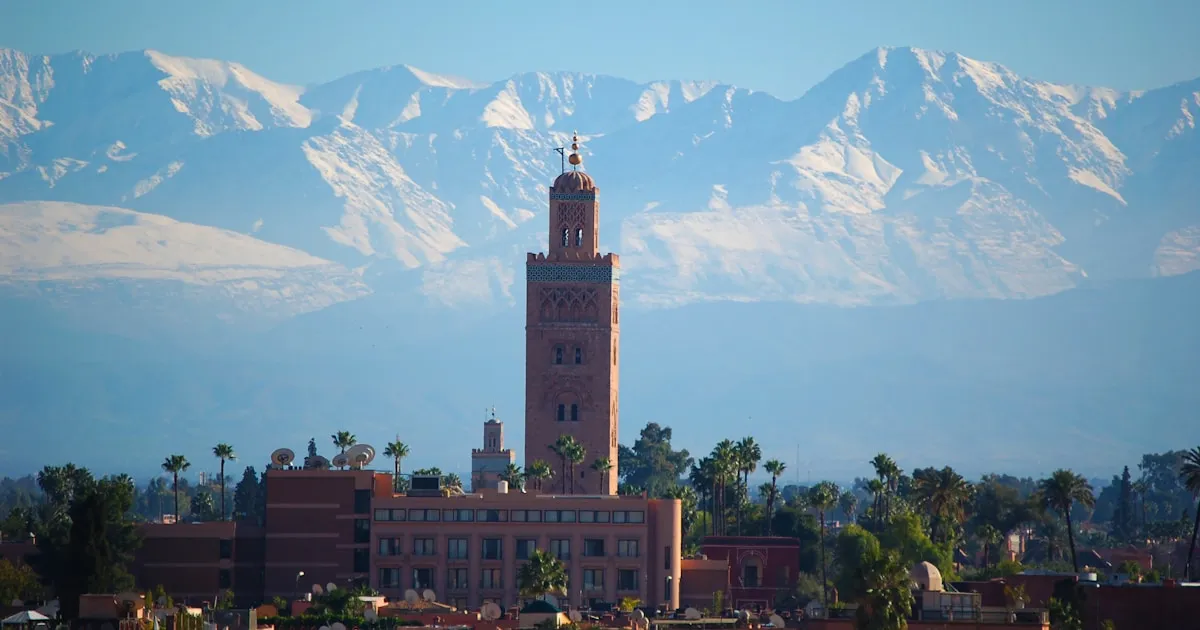
The Views Are Spectacular — But Not What You Think
Most people who book a hot air balloon in Marrakech expect to float over the city's famous medina, soaring above the minarets and the Jemaa el-Fna square. Others imagine drifting directly over the snow-capped peaks of the Atlas Mountains. Neither of these is accurate, and if you go in with those expectations, you will be confused for about thirty seconds — before realising that what you actually see is far more interesting.
Hot air balloon flights in Marrakech do not launch from the city. They launch from the Palmerie and the Jbilet plains on the northern edge of Marrakech, roughly 20 to 30 kilometres from the medina. The Atlas Mountains are not below you — they are in front of you, forming a dramatic wall along the entire southern horizon. And the landscape you drift over is not urban sprawl but an ancient patchwork of palm groves, Berber villages, and agricultural land.
This is a guide to what you actually see from a hot air balloon in Marrakech — every detail, season by season, altitude by altitude.
The Jbilet Desert Plains
The first thing that strikes you as you ascend is the vastness. The Jbilet region is a rocky, semi-arid plateau that stretches in every direction. The ground is flat, dry and coloured in shades of ochre, rust and pale sand. From above, it looks almost lunar — a textured surface of low scrub, exposed rock and winding dirt tracks used by shepherds and farmers.
This is not the Sahara. There are no towering dunes. The Jbilet is a different kind of desert: ancient, eroded, quietly beautiful. The patterns in the earth — dried riverbeds, stone walls dividing grazing land, faint vehicle tracks disappearing into the distance — become visible only from altitude. At ground level, the landscape can look monotonous. From 500 metres up, it reveals a hidden geometry.
The colour of the plains shifts dramatically depending on the time of year and the angle of the sunlight. In the first minutes after sunrise, the entire plateau glows a deep amber. As the sun climbs, the tones flatten to pale gold and tan. In winter, patches of green appear where seasonal rains have brought the scrub to life.
The Atlas Mountains
This is the view that defines hot air balloon Marrakech views more than any other.
The High Atlas range runs roughly east to west across the southern horizon. From the basket of a balloon at 800 metres, you are looking at a wall of mountains that stretches as far as you can see in both directions. On a clear morning — and most mornings in Marrakech are clear — the visibility is extraordinary.
Jebel Toubkal and the High Peaks
Jebel Toubkal, the highest peak in North Africa at 4,167 metres, is visible on most flights. It sits roughly 65 kilometres to the south of the typical launch site, and from altitude it appears as a broad, snow-dusted summit rising above its neighbours. In winter, the snow line drops to around 2,500 metres, and the entire upper third of the range is white. The contrast between the warm desert tones below you and the cold, jagged peaks on the horizon is one of the most photographed scenes in Moroccan tourism.
The Foothills
Between the flat plains and the high peaks, the Atlas foothills roll in layered ridges. From the balloon, you can see the valleys carved by rivers over millennia, the terraced hillsides where Berber communities farm, and the winding roads that connect mountain villages. The detail visible from a balloon is remarkable — you can pick out individual houses, groves of walnut trees and the switchback paths used by mules.
How the Mountains Catch the Light
The Atlas Mountains are the first thing to catch the sunrise. While the plains below are still in grey shadow, the highest peaks glow pink, then orange, then brilliant white as the sun crests the horizon. This progression takes roughly 15 to 20 minutes and is one of the most visually dramatic sequences you will ever witness. Our sunrise guide covers the full timeline of a dawn flight.
Berber Villages from Above
Scattered across the plains and clustered along dry riverbeds, the Berber villages of the Jbilet region are one of the most fascinating things to see from a balloon. These are small, mud-brick settlements — some no more than four or five houses grouped around a central courtyard. From above, they form geometric patterns: rectangular compounds, flat rooftops used for drying crops, low walls enclosing livestock pens.
At lower altitudes — when the pilot drops to 100 or 200 metres — you can see remarkable detail. Laundry drying on a rooftop. Children running out to wave at the balloon. A woman tending a bread oven in a courtyard. Goats clustered under a tree. These moments are fleeting and unscripted, and they give you a glimpse of daily life in rural Morocco that no guided tour of the medina can replicate.
The villages are connected by narrow dirt tracks, and from altitude you can trace these paths across the landscape like veins on a leaf. Occasionally you spot a motorbike or a donkey cart moving along them, raising a small cloud of dust.
Palm Groves and Agricultural Land
Not everything below is desert. The Marrakech region sits on the Haouz Plain, which is irrigated by an ancient system of channels — known as khettaras — that carry water from the Atlas Mountains to the farmland. From a balloon, you can see these irrigation networks clearly: straight lines of darker earth cutting through the pale landscape, feeding clusters of green.
The Palmerie
The Palmerie, a vast grove of date palms northeast of Marrakech, is sometimes visible depending on your flight path. From above, it appears as a dense, dark-green canopy — a striking contrast against the surrounding desert. The individual palms form neat rows where they have been cultivated and wild, tangled clusters where they have grown naturally.
Olive Groves and Wheat Fields
Beyond the palms, the agricultural land of the Haouz Plain produces olives, wheat, barley and vegetables. In winter and spring, these fields are vivid green — geometric rectangles and irregular patches of colour that break up the ochre monotone of the desert. By late summer, the same fields have turned golden brown after the harvest, and the landscape takes on a uniform warmth.
The contrast between irrigated and non-irrigated land is stark from the air. You can see exactly where the water reaches and where it does not — a green line that ends abruptly at the edge of the desert.
Other Balloons in the Sky
On a typical morning during peak season, between 15 and 25 balloons launch from the same general area. This might sound crowded, but from the air it is anything but. The balloons spread across a wide area, drifting at slightly different speeds and altitudes depending on the wind layers each pilot catches.
The result is one of the best photo opportunities of the entire flight. Brightly coloured balloons dotted across a vast landscape, with the Atlas Mountains behind them and the sunrise light painting everything gold. These shots — a single balloon floating above the desert with the mountains on the horizon — are the images that define the Marrakech ballooning experience.
If you want to capture these moments well, our photography tips guide covers camera settings, composition and the best moments to shoot during the flight.
Wildlife and Ground Activity
The balloon ride is not a safari, but you do see life on the ground. Shepherds with flocks of goats and sheep are common, especially near the villages. Occasionally a flock of birds — starlings, swallows or kestrels — passes below or alongside the balloon. At lower altitudes, you might spot a hare darting across open ground or a raptor circling on a thermal.
The human activity is equally interesting. Farmers heading out to their fields at dawn. A group of men gathered around a well. A truck loaded with hay bouncing along a dirt road. The scale of human presence against the vastness of the landscape is humbling — from 800 metres, a village that houses 200 people looks like a handful of dice scattered on a table.
The Sunrise Itself
The sunrise is not just a backdrop — it is the centrepiece of the entire experience.
Your balloon typically lifts off roughly 15 to 20 minutes before the sun appears. At this point, the sky is a deep indigo in the west and a band of warm colour — purple, rose, amber — building along the eastern horizon. The landscape below is monochrome: grey, featureless, flat. You can see the outlines of villages and palms, but nothing has colour yet.
Then the sun breaks the horizon. The sequence that follows lasts about 10 minutes and moves fast:
- The Atlas peaks catch the first light — a thin line of pink along their summits
- The colour deepens to orange and floods down the mountain slopes
- The plains below shift from grey to warm ochre as the light sweeps westward
- Your own balloon casts an enormous shadow across the desert, stretching hundreds of metres
- The other balloons in the sky begin to glow as the light hits their envelopes
By the time the sun is fully up, the entire landscape has transformed. What was a grey, flat expanse is now a richly textured world of colour, shadow and depth. The speed of this transformation — from darkness to full daylight in under 20 minutes — is something that you cannot appreciate from the ground.
Seasonal Differences in What You See
The hot air balloon Marrakech views change significantly throughout the year. Here is what to expect in each season.
Winter (December to February)
- Heavy snow on the Atlas Mountains, often down to 2,500 metres
- Green patches across the plains from winter rainfall
- Crisp, cold air with exceptional visibility — often 60 kilometres or more
- Golden morning light with long shadows
- The coldest flights (5 to 10 degrees at altitude), but visually the most dramatic
Spring (March to May)
- Wildflowers blooming across parts of the Haouz Plain
- Lush green agricultural land — wheat fields at their most vivid
- The Atlas still snow-capped but the snow line retreating
- Warm, soft light preferred by photographers
- Many experienced visitors consider this the best season for a balloon ride
Summer (June to September)
- Brown and golden tones dominate — the landscape is dry and warm
- Heat haze can reduce visibility on the horizon, though early morning flights avoid the worst of it
- Flights launch at the earliest times of the year (around 5:30 AM)
- The Atlas Mountains appear in sharp, snow-free relief
- Fewer tourists, meaning fewer balloons in the air
Autumn (October to November)
- Warm amber light and clear skies
- Harvest season — you may see farmers working the fields below
- The first dusting of snow returns to the highest Atlas peaks
- Peak season for ballooning — the combination of mild weather, clear air and dramatic light is ideal
For a deeper look at how seasons affect your flight, see our best time to fly guide.
Altitude and Perspective
Your pilot controls the balloon's altitude by adjusting the burner and the vent at the top of the envelope. During a typical 45 to 60 minute flight, you will experience a range of heights — and each one offers something different.
100 to 200 metres: Low-level flight. You can see individual people, animals and buildings in detail. Villagers wave. Dogs bark. You feel close to the landscape and can hear sounds from the ground clearly.
300 to 500 metres: Mid-altitude. The villages shrink to clusters of rectangles. The irrigation channels become visible as a network. The palm groves reveal their full extent. This is the altitude where the relationship between water and settlement becomes obvious — every village sits where the water is.
500 to 1,000 metres: High altitude. The panoramic view opens up. The Atlas Mountains fill the southern horizon. The curve of the earth becomes faintly perceptible. On a clear day, visibility extends 50 kilometres or more. Individual details on the ground are lost, but the grand sweep of the landscape — desert, mountains, oases, sky — is breathtaking.
Most pilots alternate between these levels, giving you both intimate close-ups and sweeping panoramas during a single flight.
Why This Landscape Is Special
There are balloon rides available all over the world — Cappadocia, Luxor, Bagan, the Serengeti. Each has its own appeal. What makes the Marrakech experience distinctive is the contrast.
Within a single panoramic view, you see true desert, snow-capped mountains rising to over 4,000 metres, green oases fed by ancient irrigation, and human settlements that have existed in the same form for centuries. That combination — arid plains, high peaks, cultivated green, and living history — does not exist in the same frame anywhere else.
If you are weighing up Marrakech against other destinations, our Marrakech vs Cappadocia comparison breaks down the differences in detail.
Book Your Flight
The views from a hot air balloon in Marrakech are unlike anything you have seen before — not because they match the postcard expectations, but because they replace them with something better.
Our Classic Flight includes hotel transfers, a 45-minute flight and a traditional Moroccan breakfast after landing. For a longer, more exclusive experience with an extended flight and a premium breakfast served in a private desert setting, the VIP Flight is the way to go.
View all flight options and see the real Marrakech from above.