
The hot air balloon is the oldest form of human flight. Before the Wright brothers, before gliders, before anyone had even conceived of an engine that could power a heavier-than-air machine, two brothers in southern France watched smoke rise from a fire and asked a question that changed history: what if we could ride it?
This is the complete story of hot air ballooning — from ancient sky lanterns to modern tourism, from sheep and roosters to Champagne toasts over the Atlas Mountains.
Prehistory: The Chinese Sky Lantern
Long before anyone in Europe thought about flight, the Chinese were launching small hot air balloons. Sky lanterns — thin paper bags with a small fuel cell at the base — date back to at least the 3rd century BC. Attributed to the military strategist Zhuge Liang during the Three Kingdoms period, they were used for signalling and communication between troops.
These were not manned flights, and there is no evidence the Chinese considered scaling the concept up to carry humans. But the underlying principle — that heated air rises and can lift a lightweight structure — was understood in Asia more than two thousand years before the Montgolfier brothers demonstrated it in France.
1782: The Observation That Started Everything
In Annonay, a small town in the Ardeche region of southern France, Joseph-Michel and Jacques-Etienne Montgolfier ran a successful paper manufacturing business. The family was prosperous, educated, and curious about the natural sciences.
The origin story varies depending on the source, but the most widely accepted account describes Joseph watching laundry dry over a fire. The fabric billowed upward as hot air filled it, rising away from the heat source. He began experimenting, first with paper bags held over flames, then with larger fabric enclosures. Each time, the result was the same: heated air lifted the container.
The Montgolfiers did not fully understand the science — they believed it was smoke, not heat, that provided the lift, and they experimented with burning damp straw and wool to produce as much smoke as possible. Their theory was wrong, but their engineering was sound.
4 June 1783: The First Public Demonstration
The Montgolfiers' first public demonstration took place in the marketplace of Annonay. Before a crowd of local dignitaries and townspeople, they inflated a large linen-and-paper balloon — roughly 10 metres in diameter — over a fire of straw and wool. When released, it rose to an estimated altitude of 1,800 metres and drifted for approximately 10 minutes before landing in a field two kilometres away.
Word of the demonstration reached Paris within days. The Academie des Sciences was intrigued. King Louis XVI was fascinated. The Montgolfier brothers were summoned to the capital.
19 September 1783: The Versailles Flight — A Sheep, a Duck and a Rooster
Before anyone would risk a human life, the question of whether living creatures could survive at altitude needed answering. At the Palace of Versailles, before King Louis XVI, Queen Marie Antoinette, and a crowd estimated at 130,000, the Montgolfiers launched a balloon carrying three passengers: a sheep named Montauciel ("Climb-to-the-sky"), a duck, and a rooster.
The balloon flew for approximately eight minutes, covering three kilometres and reaching an altitude of about 460 metres. All three animals landed safely — though the rooster sustained a minor injury, later attributed to the sheep stepping on it rather than any atmospheric effect. The path to human flight was clear.
21 November 1783: The First Manned Free Flight
This is the date that marks the beginning of human aviation. Jean-Francois Pilatre de Rozier, a young physicist, and Francois Laurent, Marquis d'Arlandes, a military officer, climbed into a Montgolfier balloon in the Bois de Boulogne, Paris.
The balloon rose above the Paris skyline and drifted south-east for approximately 25 minutes, covering about 9 kilometres at an altitude of roughly 900 metres. The two men tended a fire in a brazier slung beneath the envelope, feeding it straw to maintain lift. At one point, the envelope fabric caught fire, and they doused the flames with wet sponges they had wisely brought aboard.
They landed safely on the Butte-aux-Cailles, on what is now the 13th arrondissement. Humanity had flown.
December 1783: The Hydrogen Balloon
Just ten days after the Montgolfier flight, the physicist Jacques Charles launched a hydrogen-filled balloon from the Tuileries Garden in Paris. Charles and his co-pilot, Nicolas-Louis Robert, flew for over two hours, covering 36 kilometres.
Hydrogen provided far more lift per cubic metre than hot air and did not require a fire, making the balloon lighter, more controllable, and less prone to catching alight. For the next 180 years, gas balloons — filled with hydrogen and later helium — dominated the field, while hot air balloons faded into relative obscurity.
1785: The First Channel Crossing
On 7 January 1785, Jean-Pierre Blanchard and John Jeffries crossed the English Channel in a hydrogen balloon, flying from Dover to Calais. The flight was dramatic: they lost altitude over the Channel and had to jettison virtually everything — including most of their clothing — to stay airborne. They landed in a forest near Calais, cold but triumphant.
1794: Balloons Go to War
The French Revolutionary Army established the world's first military balloon unit, the Compagnie d'Aerostatiers, in 1794. At the Battle of Fleurus in Belgium, a hydrogen observation balloon named l'Entreprenant was used for aerial reconnaissance — a military observer floated above the battlefield for hours, reporting enemy positions to commanders below.
This marked the first operational military use of aircraft. Observation balloons would go on to play significant roles in the American Civil War, the Franco-Prussian War, and both World Wars.
The 1800s: Science and Spectacle
Throughout the 19th century, balloons served two principal purposes: scientific research and public entertainment.
Scientists used balloons to study the atmosphere at altitudes previously unreachable. In 1862, James Glaisher and Henry Coxwell reached an estimated 11,000 metres — so high that Glaisher lost consciousness and Coxwell, his hands frozen, had to pull the gas valve cord with his teeth to begin the descent.
Meanwhile, balloon ascents became wildly popular public spectacles. Showmen charged admission to crowds who gathered to watch launches and parachute jumps from great heights.
1852: The First Powered Airship
Henri Giffard, a French engineer, attached a small steam engine to a cigar-shaped hydrogen balloon and flew 27 kilometres from Paris to Elancourt. It was the first powered, controlled, sustained flight of any kind — half a century before the Wright brothers. Giffard's airship was slow (only 10 km/h) and could not fly against the wind, but it demonstrated that powered aerial navigation was possible.
Early 1900s: Eclipsed by Powered Flight
The Wright brothers' first powered aeroplane flight at Kitty Hawk in 1903 did not immediately end the age of balloons — airships remained dominant in long-distance travel through the 1920s and 1930s. But the development of fixed-wing aircraft and, later, helicopters progressively marginalised lighter-than-air flight. By the mid-20th century, ballooning was all but dead as a practical pursuit.
1931: Piccard Reaches the Stratosphere
The Swiss physicist Auguste Piccard and his assistant Paul Kipfer ascended to 15,781 metres (51,775 feet) in a pressurised aluminium gondola suspended beneath a hydrogen balloon. It was the first time any human had entered the stratosphere. Piccard made the journey to study cosmic rays, and his achievement demonstrated that balloons could still go where no other vehicle could.
1960: Ed Yost and the Rebirth of Hot Air Ballooning
This is the pivotal moment in the story — the point where hot air ballooning, dormant for nearly two centuries, was reinvented for the modern age.
Ed Yost, an American engineer from Bristow, Iowa, had been experimenting with ways to make hot air balloons practical. His breakthrough was to use propane gas burned through a purpose-built burner that directed a precise, controllable flame into the mouth of a nylon envelope — replacing the Montgolfiers' dangerous open fires.
On 22 October 1960, Yost launched his first modern hot air balloon from Bruning, Nebraska. The flight lasted 25 minutes, but the technology was revolutionary. Propane burners gave pilots precise altitude control. Nylon envelopes were lightweight, durable, and fire-resistant. The entire system could be transported in a trailer, inflated in minutes, and packed up by a small crew.
Ed Yost is rightly called the "father of modern hot air ballooning." His invention transformed a historical curiosity into a viable sport and, eventually, a global tourism industry.
1960s-1980s: Sport Ballooning Explodes
Yost's propane balloon was quickly adopted by recreational pilots worldwide. Balloon festivals began appearing in the 1970s — the Albuquerque International Balloon Fiesta launched in 1972 with just 13 balloons and has grown to host over 500. Balloon racing, distance challenges, and altitude records attracted adventurous pilots.
Manufacturers like Cameron Balloons (founded in Bristol, UK, in 1971) and Ultramagic (Spain, 1985) began producing balloons in a range of sizes and shapes, making the sport accessible to a growing community of private pilots.
1991: Crossing the Pacific
On 15 January 1991, Per Lindstrand and Richard Branson launched from Miyakonojo, Japan, in the largest hot air balloon ever flown at that time. They crossed the Pacific Ocean, covering 7,672 kilometres in 46 hours before crash-landing in the Canadian Arctic. Both survived — barely — but the record stood as the longest hot air balloon flight in history.
1999: Around the World Non-Stop
The last great ballooning record — a non-stop circumnavigation of the globe — was achieved on 21 March 1999 by Bertrand Piccard (grandson of Auguste) and Brian Jones. Their balloon, the Breitling Orbiter 3, was a Roziere — a hybrid design using both helium and hot air — and the flight lasted 19 days, 21 hours, covering 40,814 kilometres.
It was the longest flight in aviation history in terms of both duration and distance, and it closed the final chapter of ballooning's great exploration era.
2000s to Present: The Age of Balloon Tourism
The 21st century has seen hot air ballooning transform from an adventurer's pursuit into a mainstream tourism product. The catalysts were destinations that combined reliable weather, stunning landscapes, and accessible pricing.
Cappadocia, Turkey
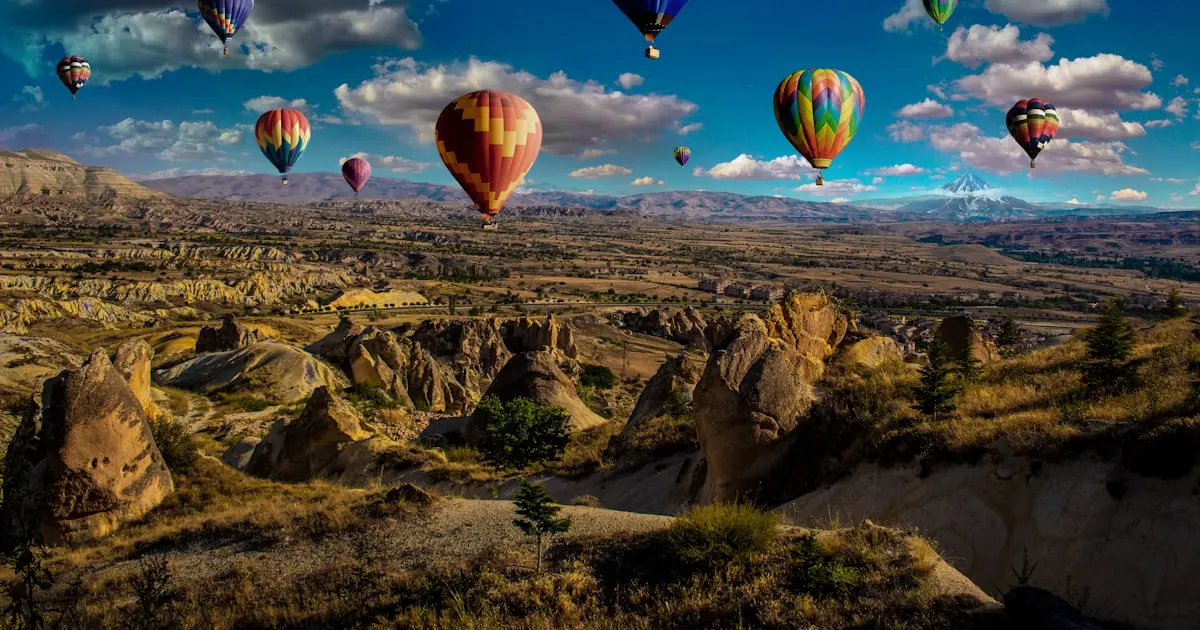
Perhaps the single location most responsible for popularising balloon tourism. The fairy chimney landscape, combined with near-perfect flying conditions, created a photogenic experience that spread virally through social media. Today, over 500,000 passengers fly annually, with up to 150 balloons launching on a single morning.
Marrakech, Morocco
Morocco's year-round flying weather and dramatic landscapes — the Atlas Mountains, the ancient Palmeraie, and the scattered Berber villages of the Haouz Plain — have made Marrakech one of the fastest-growing balloon tourism destinations in the world. The history of ballooning in Morocco is closely tied to the country's broader adventure tourism boom.
Other Major Destinations
The Serengeti and Masai Mara offer balloon safaris with unparalleled wildlife viewing. Bagan in Myanmar provides flights over thousands of ancient temples. Luxor in Egypt floats passengers above the Valley of the Kings. Each destination brings its own character to the ballooning experience. For a global overview, see our guide to the best hot air balloon destinations in the world.
By the Numbers: Ballooning Today
The global hot air balloon fleet is estimated at 7,000 to 10,000 registered aircraft. The United States has the largest fleet (roughly 3,500), followed by the United Kingdom (around 1,000) and France (about 800). Commercial balloon tourism is a global industry estimated at $250 to $300 million annually.
The journey from that first demonstration in a French marketplace to a sunrise flight over the Moroccan desert spans 243 years of invention, courage, and wonder. The technology has changed — nylon replaced linen, propane replaced straw, GPS replaced guesswork — but the fundamental experience has not. You stand in a basket, heated air lifts you skyward, and the world transforms into something breathtakingly beautiful.
Write Your Own Chapter in the Story
Every hot air balloon flight is a small piece of aviation history. Book your sunrise flight over Marrakech and join the 243-year tradition of humans taking to the sky in the simplest, most beautiful way ever invented.
Planning your morning? See what a hot air balloon ride Marrakech actually includes before you book.