
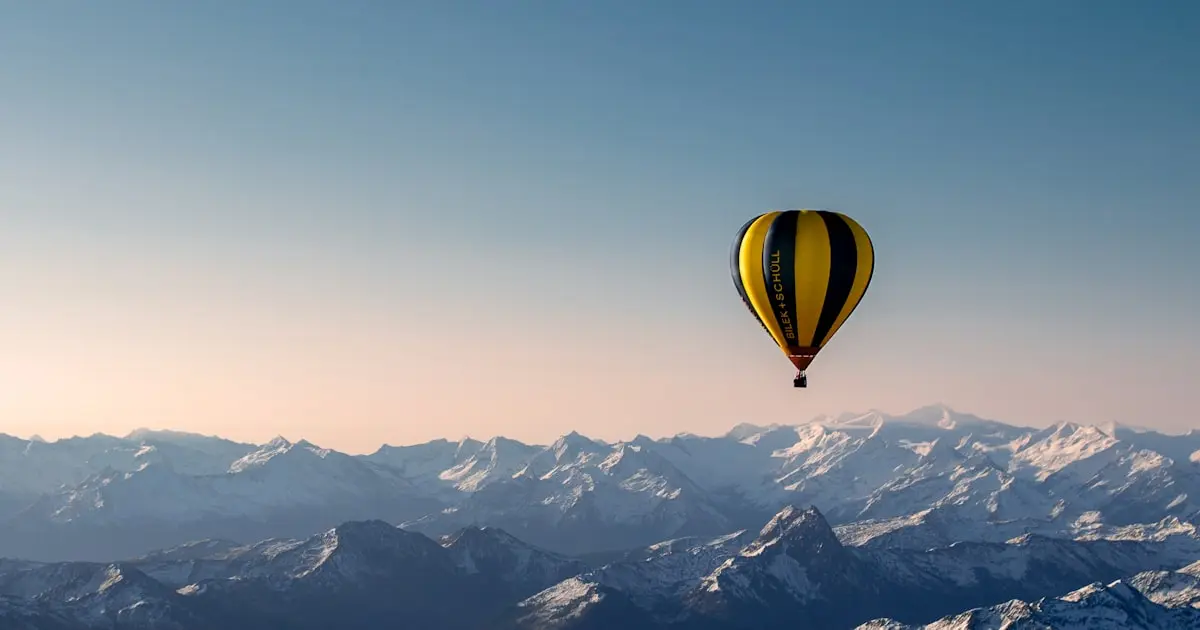
Flying a hot air balloon is unlike any other form of aviation. There is no cockpit, no engine, no runway, and no flight path programmed into a computer. The pilot stands in a wicker basket, reads the sky, and works with the wind rather than against it. It is part science, part art, and part intuition built through hundreds of hours of experience.
Whether you are curious about what happens behind the scenes on a passenger flight, considering pilot training, or simply want to understand the process before your first ride, this is the complete step-by-step breakdown — from the 4 a.m. weather check to the post-flight champagne toast.
Step 1: The Pre-Dawn Weather Check
Everything begins with the weather. A balloon has no engine and cannot fly against the wind, which means conditions must be near-perfect for a safe flight. At around 4 a.m. — sometimes earlier — the pilot studies multiple weather sources.
Surface wind speed is the most critical factor. Most operators set a maximum of 10 to 12 knots for launch and landing. Above that, the basket hits the ground too hard. The pilot also checks wind at altitude (where the balloon will cruise), visibility, cloud base, precipitation forecasts, and the likelihood of thermal activity as the sun heats the ground.
In many countries, the pilot calls a dedicated meteorological briefing service for the latest observations and forecasts. In Marrakech, where conditions are typically excellent, cancellations are rare — but the check is never skipped.
This is the go/no-go decision, and it is the pilot's alone. No commercial pressure, no passenger pleading, and no amount of blue sky can override a forecast that shows dangerous conditions developing. Safety always wins. Understanding balloon safety protocols gives you a sense of how seriously this decision is taken.
Step 2: Site Selection and the Pi-Ball Test
Once the weather is approved, the pilot selects a launch site. This is not random — it depends on wind direction, available landing areas downwind, airspace restrictions, and permission from landowners.
At the launch site, the pilot performs a pi-ball test. A small helium-filled balloon — roughly the size of a party balloon — is released and tracked visually as it rises. By timing its ascent and observing how it drifts at different heights, the pilot reads the wind speed and direction at various altitudes. This is critical information: it tells the pilot which height to fly at to travel in the desired direction — the fundamental technique of how hot air balloons are steered.
Step 3: Unloading and Layout
With conditions confirmed, the crew unloads the equipment from the trailer. A full balloon system weighs several hundred kilograms and consists of three main components: the envelope (the fabric balloon itself), the basket (wicker, typically 1.2 to 1.5 metres tall), and the burner frame with fuel cylinders.
The basket is positioned upright with the burner frame attached. The envelope — which is folded and packed in a large bag — is laid out on the ground downwind of the basket, stretched to its full length. This layout is done methodically: the envelope must be untwisted, with the mouth (opening) positioned directly in front of the burner.
Step 4: Cold Inflation With the Fan
A powerful industrial fan is positioned at the mouth of the envelope and switched on. Cold ambient air floods in, gradually filling the envelope from a flat sheet of fabric into a bulbous, three-dimensional shape. Crew members hold the crown (top) and sides to prevent it from rolling in any breeze while the pilot checks that the fabric is filling symmetrically.
Cold inflation takes three to five minutes. By the end, the envelope is fully inflated with ambient-temperature air — lying on its side, round but not yet generating any lift. For a deeper look at the physics involved, see our article on how hot air balloons work.
Step 5: Hot Inflation With the Burner
This is the moment the balloon comes alive. The pilot ignites the burner — a powerful propane flame that can produce up to 3 million BTU of heat — and directs it into the mouth of the envelope. The air inside begins to heat, becoming less dense than the surrounding atmosphere.
The pilot fires the burner in controlled blasts, each lasting two to five seconds. Gradually, the envelope rises from horizontal to vertical, pulling itself upright with increasing force. The crew at the crown release their hold when the envelope is nearly upright, and the balloon stands tall — swaying gently, tugging at the basket.
Hot inflation takes 10 to 15 minutes. The pilot adjusts the heat carefully: too much too fast can damage the fabric or cause the balloon to lift prematurely; too little and the envelope will not stand up.
Step 6: Passenger Boarding and Safety Briefing
With the balloon upright and the burner maintaining enough heat to keep it inflated without lifting off, passengers are invited to board. Climbing into a balloon basket is not elegant — there is no door. You step on a foot hole in the basket wall and swing your leg over the top, assisted by crew members on either side.
Once everyone is aboard, the pilot delivers a safety briefing. This covers the landing position (feet together, knees slightly bent, hands gripping the rope handles inside the basket), what to do if the basket tips on landing (stay inside — it will right itself), where the fire extinguisher is located, and general behaviour expectations (do not lean over the edge, do not throw anything overboard). If you want to prepare in advance, our first-time rider's guide covers everything you need to know.
Step 7: Launch — "Weighing Off"
Launch is one of the most graceful moments in all of aviation. There is no roar of engines, no acceleration down a runway, no sudden lurch into the sky.
The pilot adds heat with the burner — long, sustained blasts — until the total lift of the heated air exceeds the total weight of the balloon, basket, passengers, fuel, and equipment. At first, the basket feels lighter on the ground. Then it lifts a centimetre. Then another. Then, almost imperceptibly, you are airborne.
This process is called "weighing off." The pilot is literally balancing lift against weight, adding heat in small increments until the balance tips in favour of ascent. The transition from ground to sky is so smooth that many passengers do not notice the exact moment they leave the earth. One second you are looking across the field; the next you are looking down at it.
Step 8: Climbing and Cruising
Once airborne, the pilot controls altitude with the burner and, on some balloons, a parachute vent at the crown of the envelope. Firing the burner heats the air and the balloon climbs. Stopping the burner allows the air to cool gradually and the balloon descends — slowly, because the air cools at a gentle rate.
The typical cruising altitude for a scenic flight is 300 to 1,000 metres, though pilots often vary the height dramatically during a single flight. You might skim over treetops at 50 metres, then climb to 800 metres for panoramic views, then drop low again to drift along a river valley. This variation is one of the joys of ballooning — the landscape reveals itself differently at every altitude.
The pilot fires the burner every few minutes to maintain altitude. Each blast is loud — a controlled roar that lasts a few seconds — followed by silence. It is in these silent intervals, drifting with the wind, that the experience becomes truly extraordinary. No engine noise. No vibration. Just the creak of wicker, the distant sounds of the landscape below, and the vast, uninterrupted sky. To understand the altitude limits, see our guide on how high hot air balloons can go.
Step 9: Reading Wind Layers for Navigation
This is where balloon piloting becomes an art form. Because a balloon has no engine, the pilot cannot steer in the conventional sense. Instead, the pilot navigates by ascending or descending into wind layers that blow in different directions.
At 200 metres, the wind might blow from the north-west. At 500 metres, it might shift to the west. At 800 metres, it might come from the south-west. By moving between these layers, the pilot can adjust the balloon's track — not with the precision of a powered aircraft, but with enough control to aim for specific landing areas and avoid obstacles.
Before and during the flight, the pilot constantly reads the wind: watching the movement of smoke, flags, trees, and surface water; monitoring the GPS track; listening to weather updates on the radio. This constant assessment is the core skill of balloon piloting and the reason it takes years to master.
Step 10: Approach and Landing
Landing is the most demanding phase of the flight. The pilot must select a suitable field (large, flat, free of livestock, power lines, and standing crops), communicate the location to the chase crew by radio, and manage the descent rate.
The approach begins several minutes before touchdown. The pilot reduces altitude gradually, aiming for a final descent rate of about 1 metre per second. Passengers are asked to assume the landing position: facing the direction of travel, knees bent, holding the rope handles firmly.
On a calm day, the basket touches gently and stays upright. With moderate surface wind, it may drag or tip onto its side before stopping — this is normal and expected. The chase crew arrive within minutes to stabilise the basket. Our detailed guide on how hot air balloons land covers every scenario.
Step 11: Deflation and Pack-Up
Once the basket is stationary and passengers have disembarked, the crew deflates the envelope. The pilot pulls a cord that opens the parachute vent at the crown, allowing hot air to escape rapidly. The envelope settles to the ground, shrinking from a 20-metre-tall structure to a vast expanse of fabric lying in the field.
The crew then walks the length of the envelope, squeezing out residual air, and rolls it tightly into a cylindrical shape. The rolled envelope is stuffed into its bag, the basket is detached from the burner frame, and everything is loaded back onto the trailer. The entire pack-up takes 20 to 40 minutes with an experienced crew.
Step 12: The Champagne Toast
No balloon flight is complete without champagne. This tradition dates back to the very earliest flights in 18th-century France, when the Montgolfier brothers' balloons alarmed farmers who had never seen anything like a giant shape descending from the sky. Pilots carried champagne to offer to landowners as a peace offering and proof that they were not demons or invaders.
Today, the toast is a celebration. Passengers gather around the deflated balloon, the pilot pops a bottle, and glasses are raised to a successful flight. In some traditions, the pilot recites the "Balloonist's Prayer" — a short verse asking for safe skies and soft landings. It is a moment of camaraderie, shared between strangers who have just experienced something genuinely extraordinary together.
Experience Every Step in Marrakech
From the pre-dawn drive through the desert to the champagne toast with the Atlas Mountains glowing in the morning light, a balloon flight in Marrakech brings every step of this guide to life. Book your flight today and experience the full magic of hot air ballooning — from launch to landing and everything in between.
Curious what it costs? See our flights and prices — no third-party booking fees.